The next tour I took with WowCo was about the history of the city of Cartago, la valiente ciudad de Cartago.
Park of the Journalists (Parque de los Periodistas)
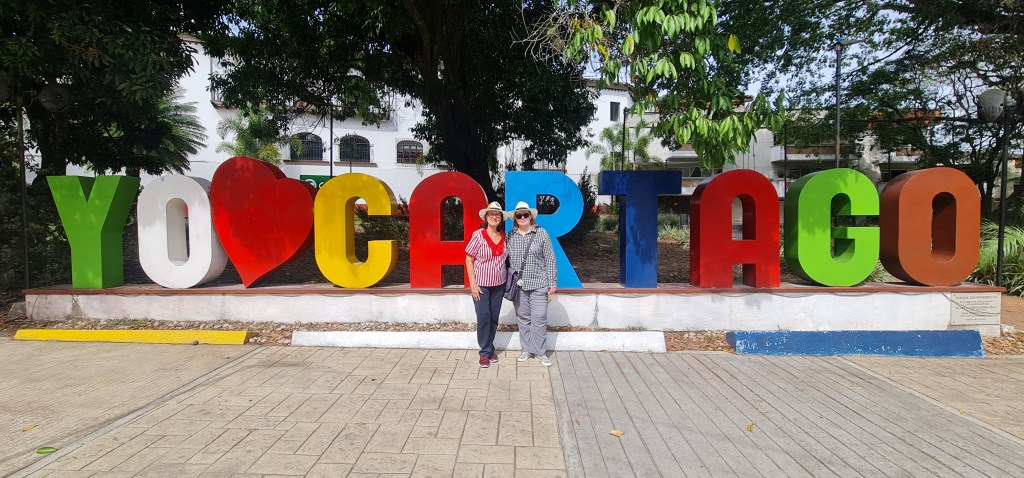
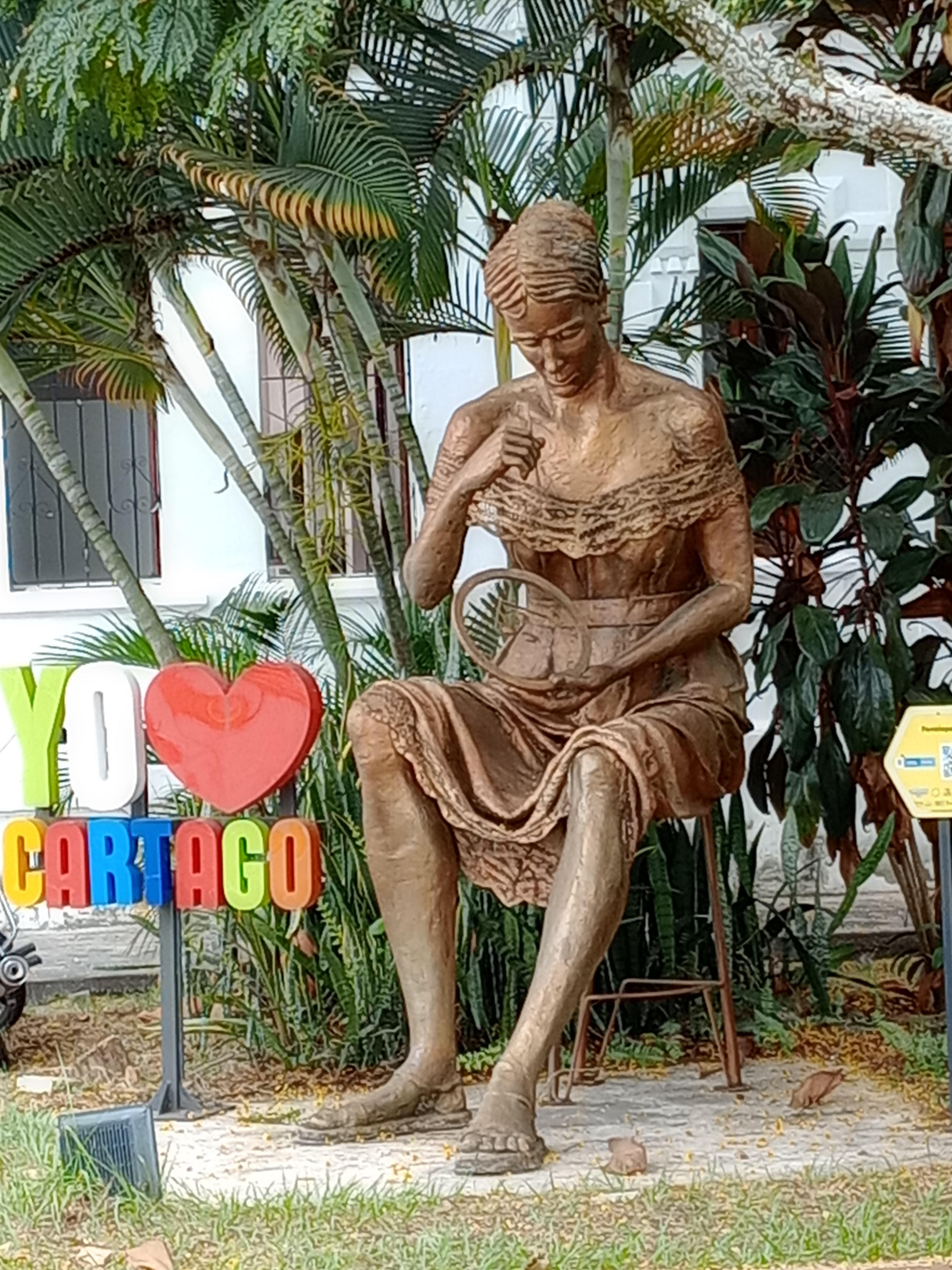
We met at the Park of the Journalists, next to the I love (heart) Cartago sign.
Isleta Park (Parque de la Isleta)
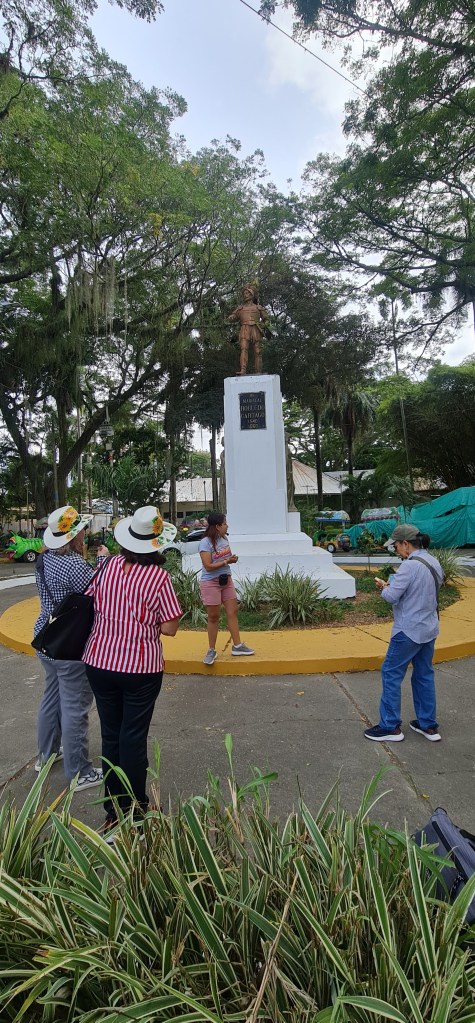
Monument to Cartago’s Founder, Marshall Jorge Robledo, Isleta Park.
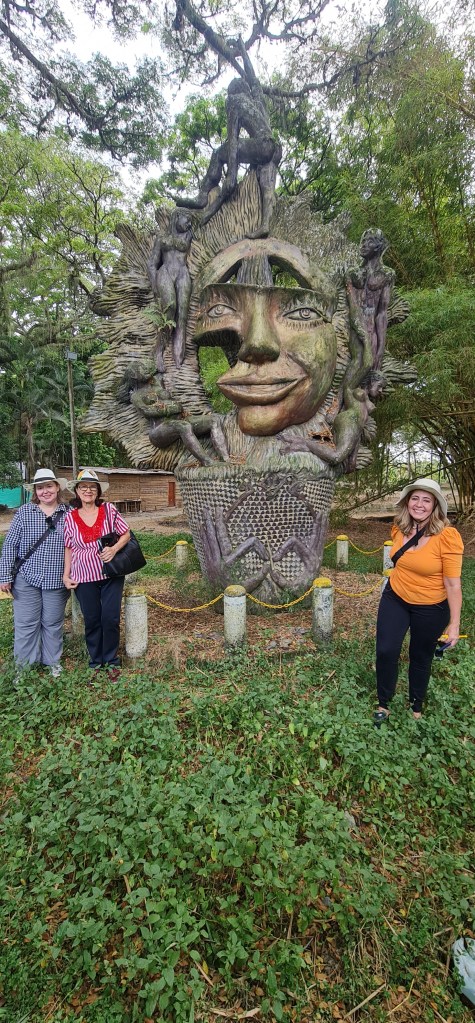
Monument to the Sun, Isleta Park.
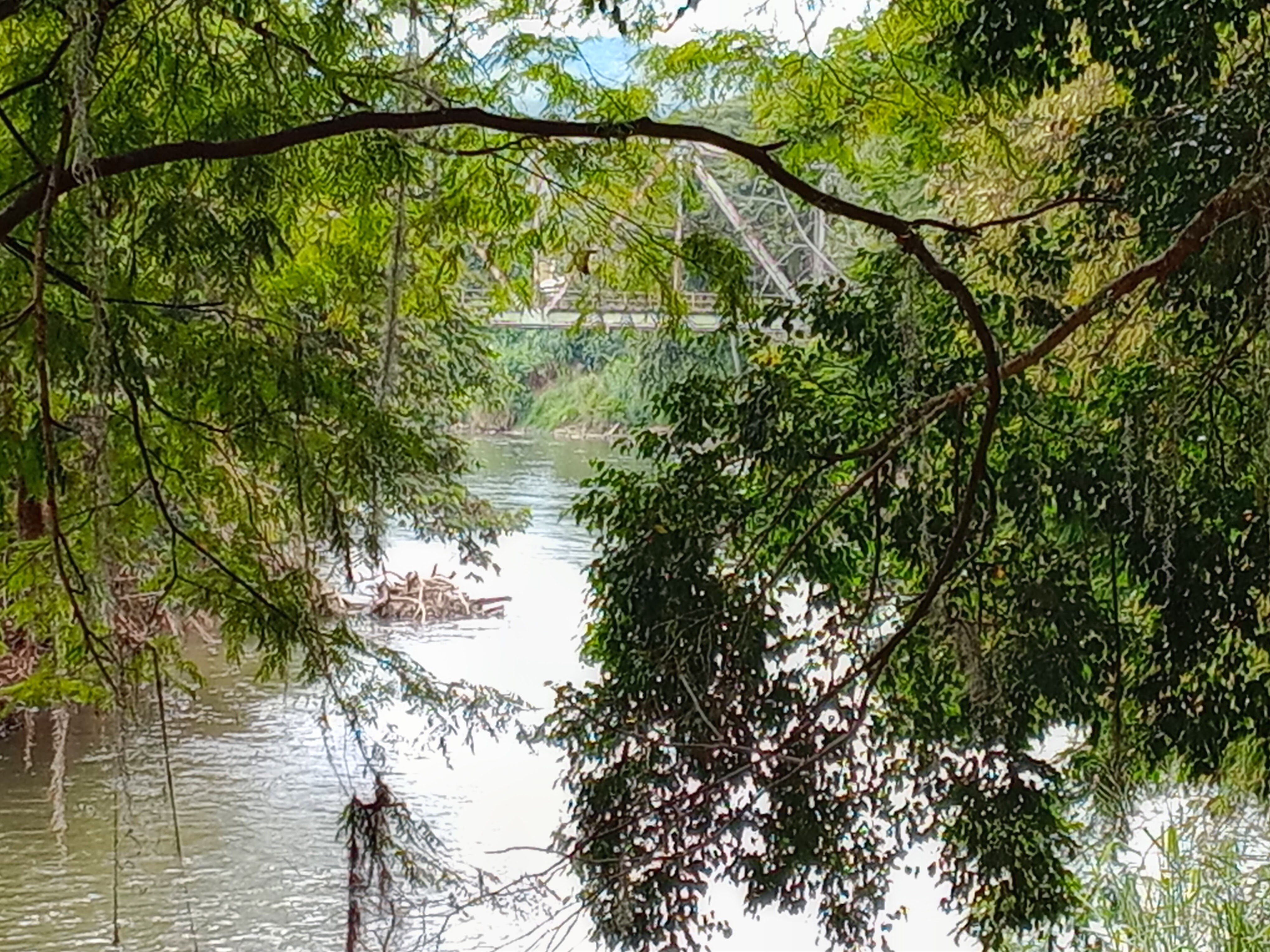
Old Railway Bridge, Crone River (Puente del Ferrocarril, Río La Vieja)
The river that passes through Cartago is called La Vieja, meaning the old lady or crone. It received this name because of a story written in the book Elegías de Varones Ilustres de Indias (Stories of Illustrious Men of the West Indies.) Captain Miguel Muñoz arrived to the area of the river that would be called the old lady/crone in 1536. He found an elderly indigenous woman dressed in fine gold jewelry. So the foreigner proceeded to steal the lady’s jewels and kill her by throwing her into the river.
There is a movement retelling the story from the elderly lady’s perspective and make her anonymous no more. They call the river Tata Yamba, meaning Yamba’s mother. This references Quimbaya Chief Yamba and imagines that it was his mother who was assaulted and killed by the Europeans.
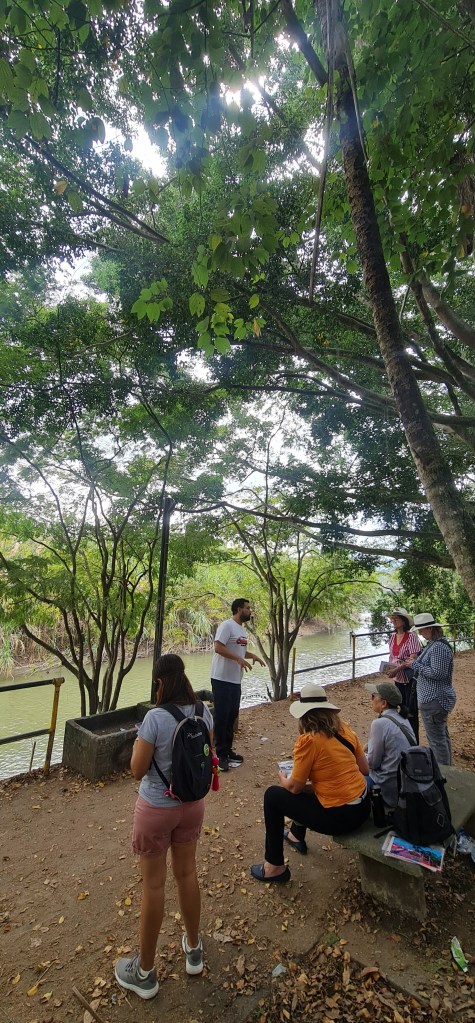
Crone/old lady (La Vieja) River. Andrés Felipe Castaño from WowCo leading the tour.
Old Railway Bridge.
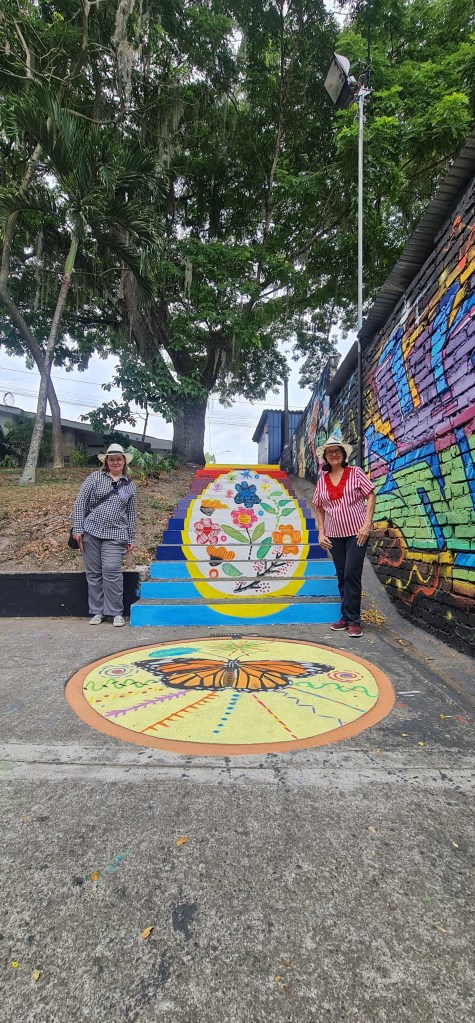
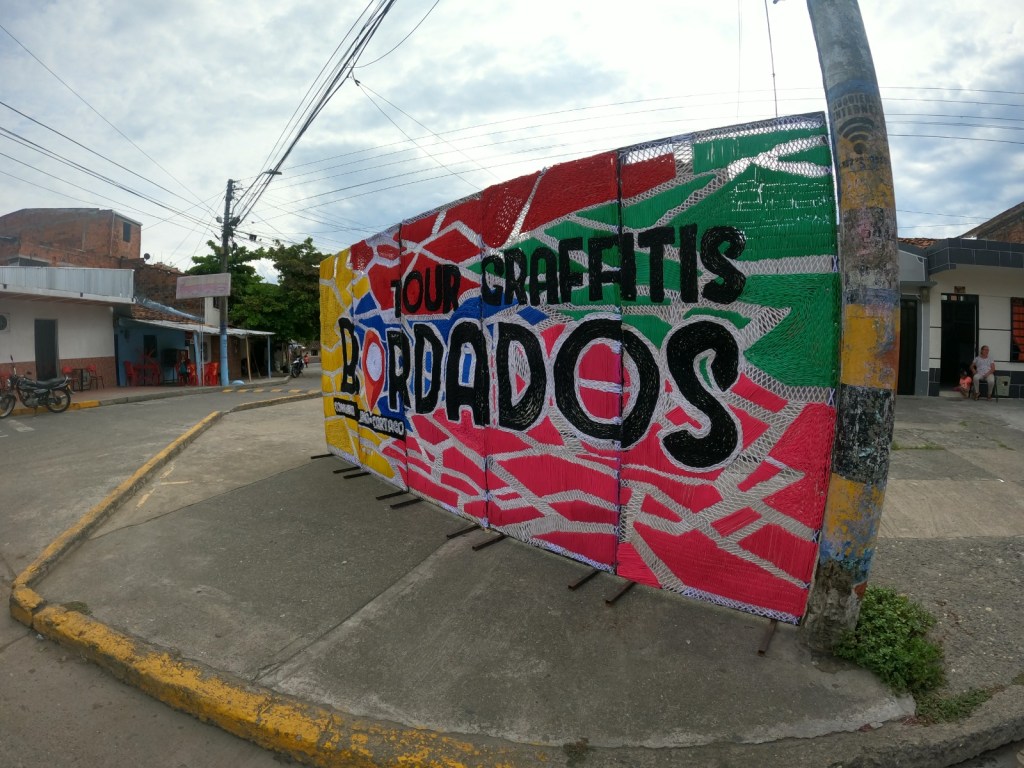
We found some new embroidery-themed floor paintings and graffitis on the way.
Embroidery-themed paintings and graffitis
Pedro Morales Pino Plaza (Plazoleta Pedro Morales Pino)
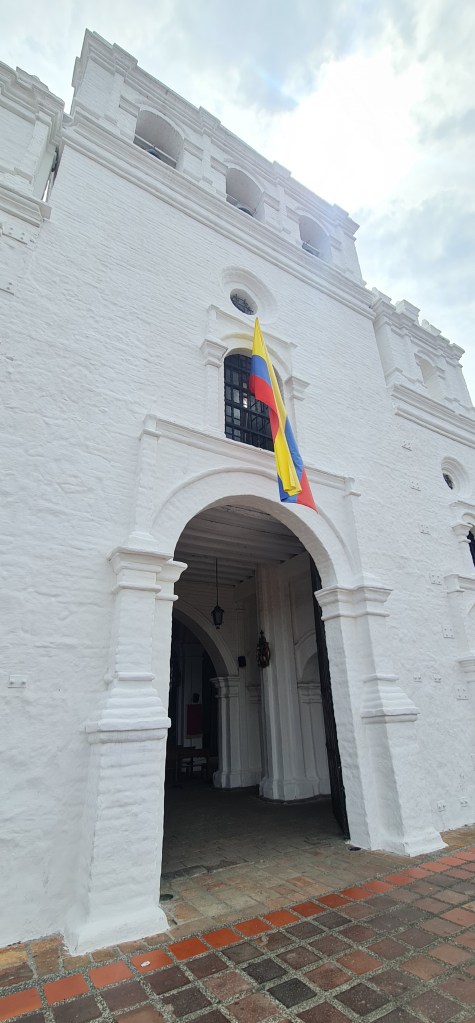
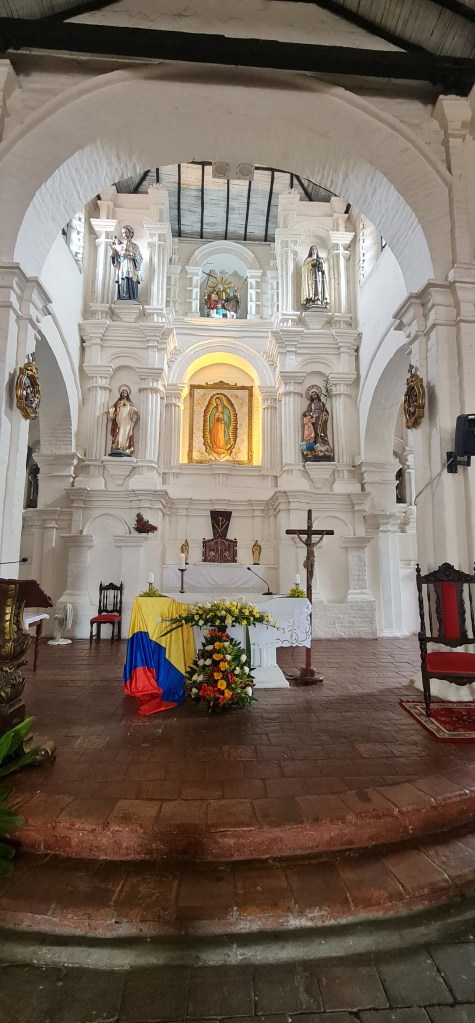
Some of Cartago’s many churches.
Church of Guadalupe
Church of Guadalupe
House of the Artisan (Casa Artesanal)
There is a really nice little store selling handicrafts in Pedro Morales Pino Plaza across from the Church of Guadalupe. It is a cooperative space where each artisan has her own space to sell her wares.
House of the Artisan
The city is seeing lots of public works improvements.
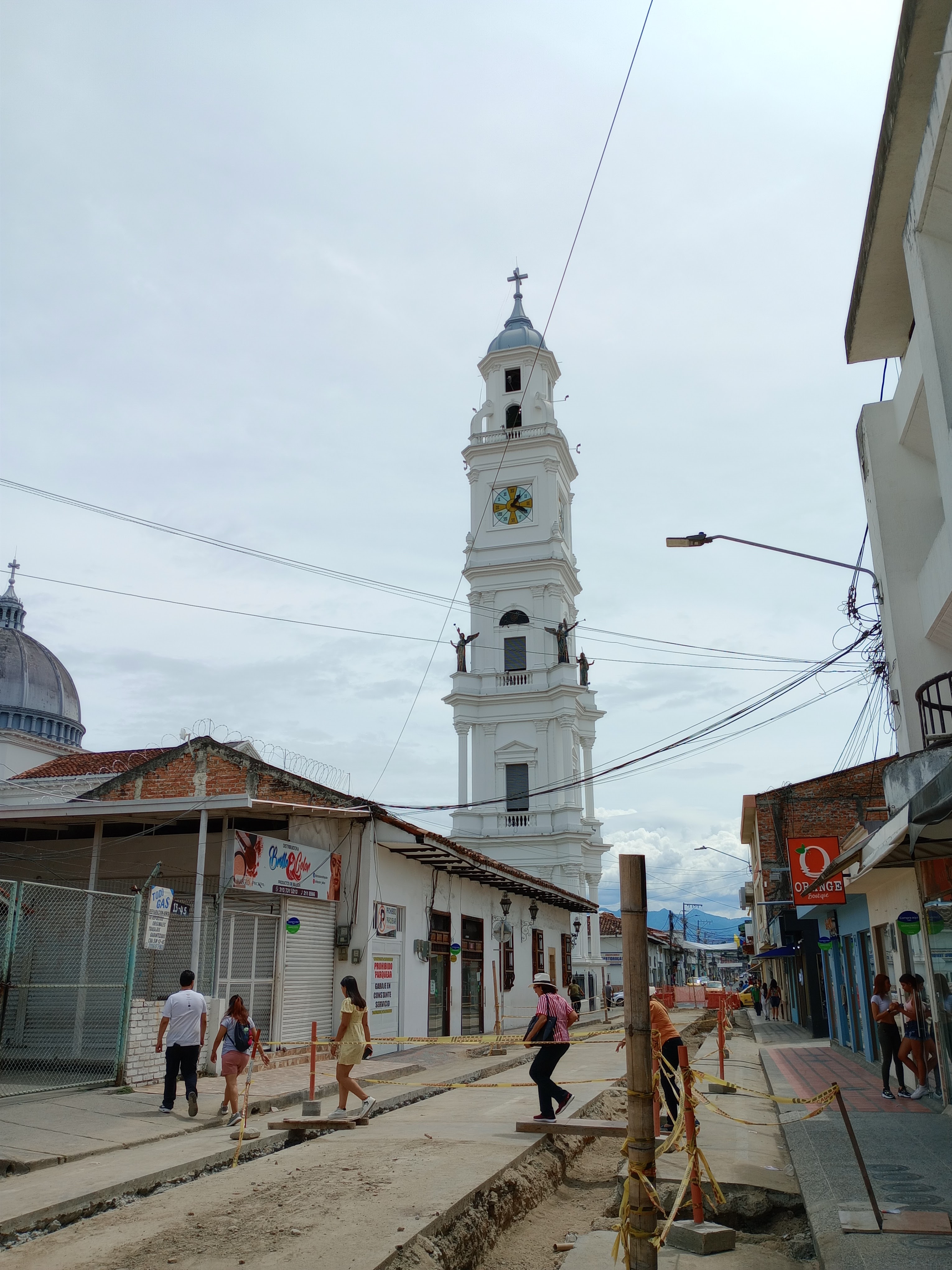
Church of Mt. Carmel bell tower
Church of Mt. Carmel
House of the Viceroy (Casa del Virrey)
The house of the Viceroy was built in the late 1700s (18th) century by the Marisancena family to allegedly receive the Viceroy José Manuel Ezpeleta.
The Pedro Morales Pino Music Conservatory is housed in the back half of the property.
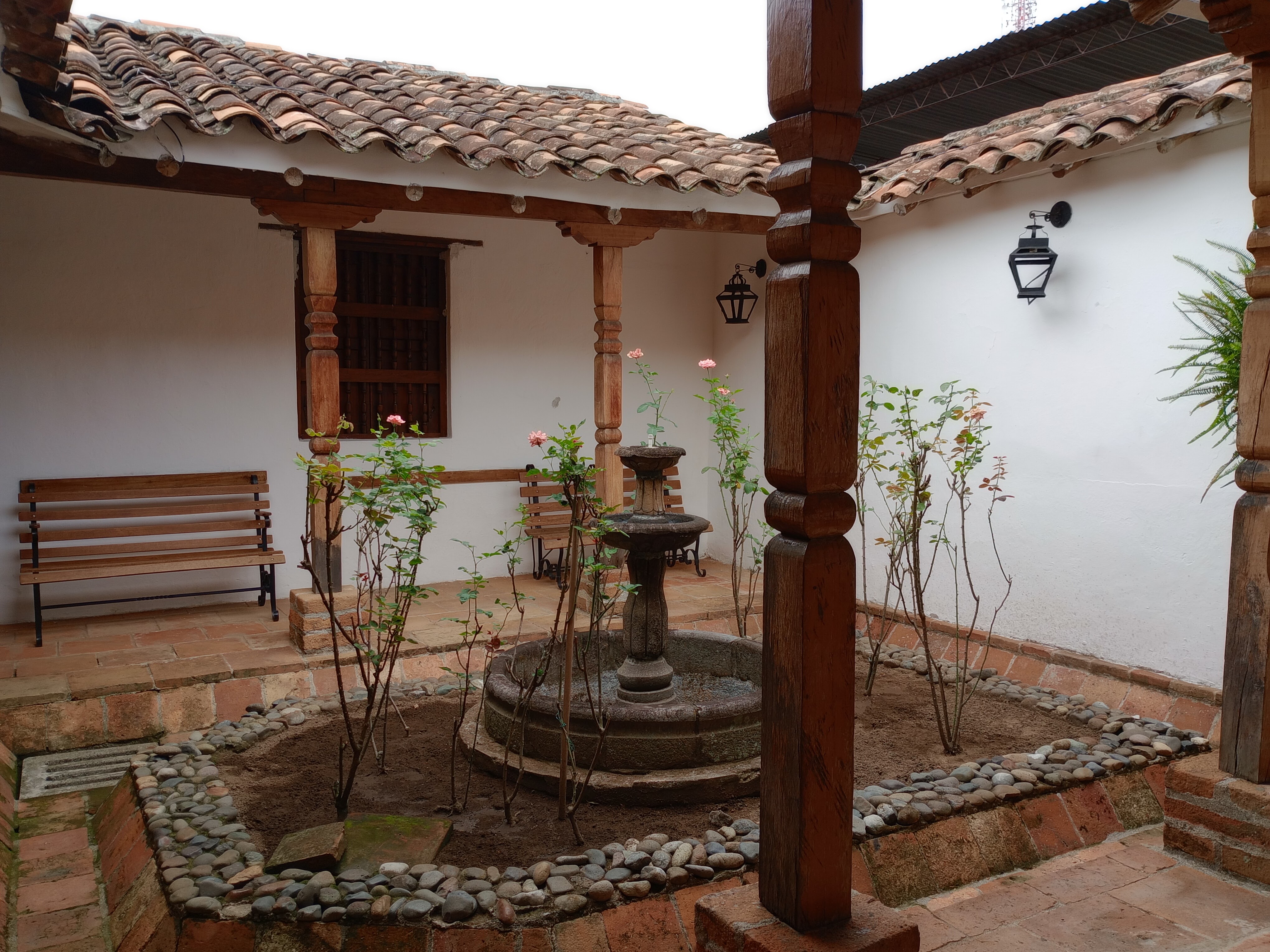
House of the Viceroy
Interior courtyard, house of the Viceroy
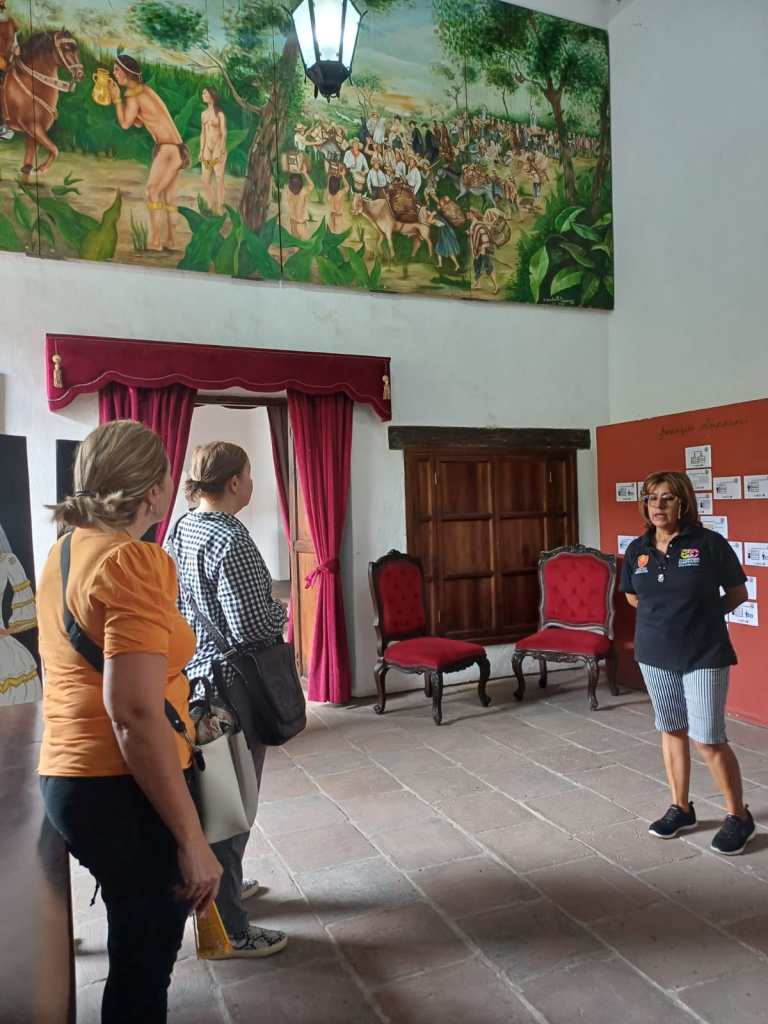
House of the Viceroy tour
Entrance, house of the Viceroy
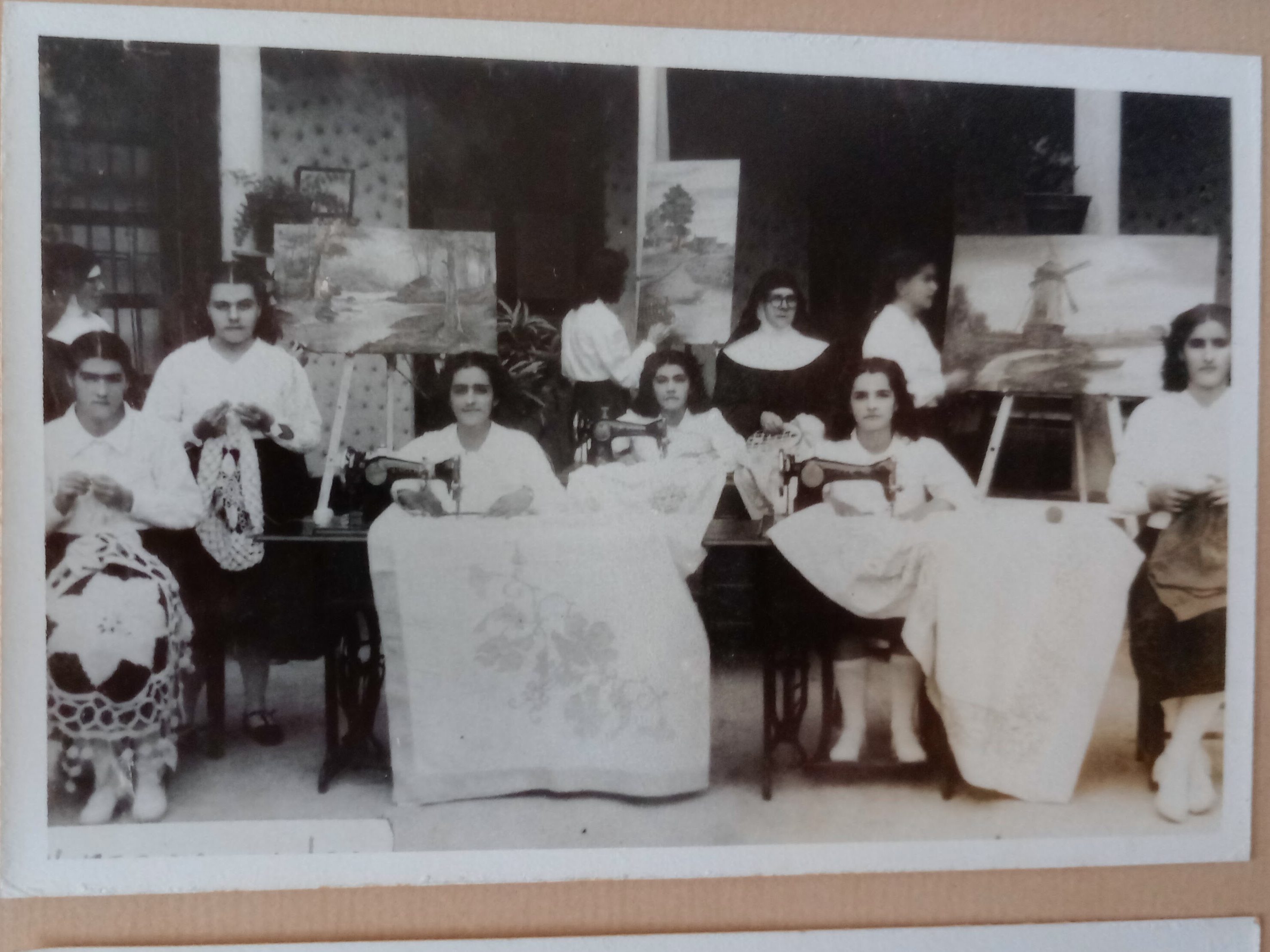
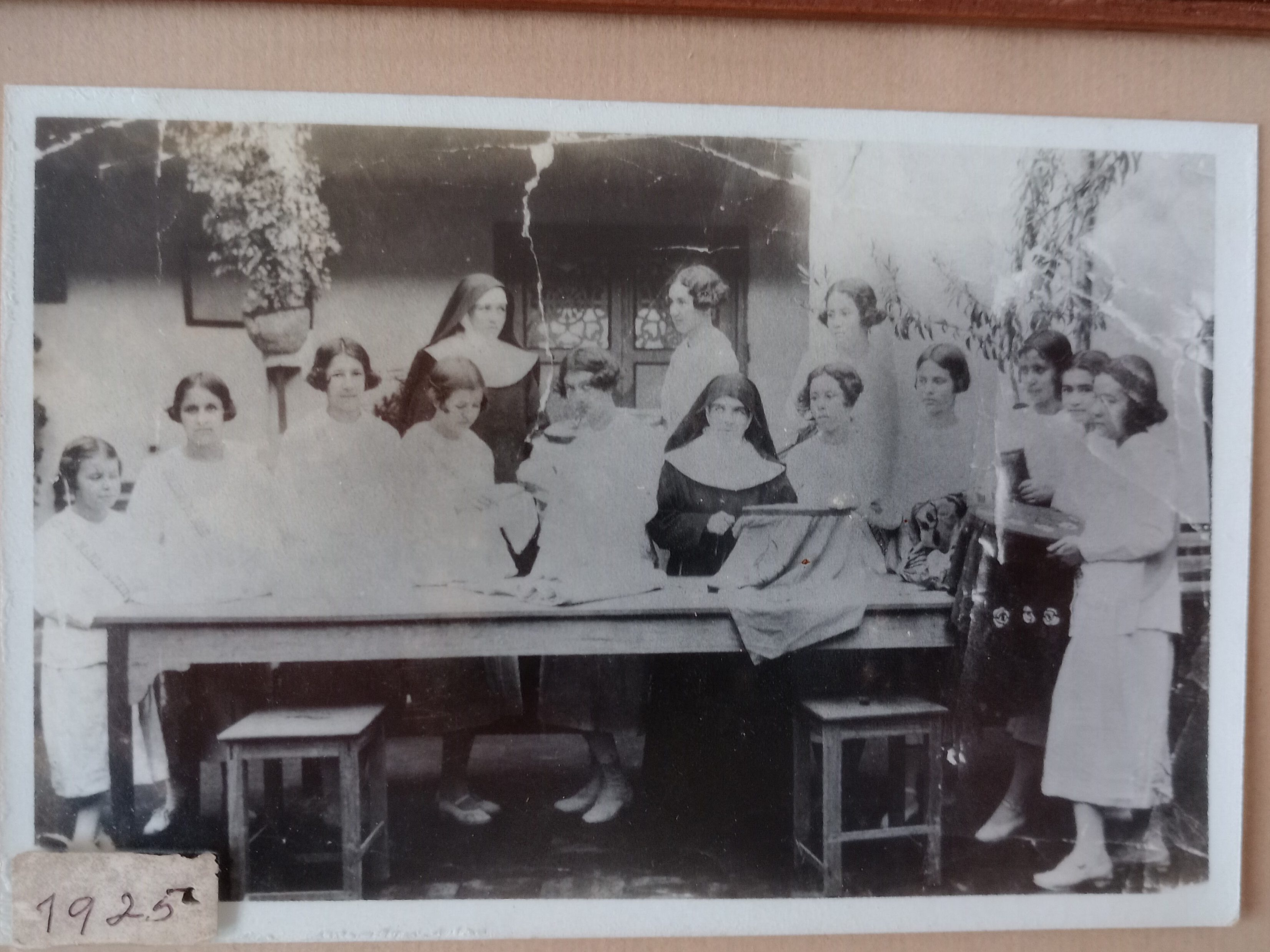
Sewing class at the María Auxiliadora (Mary help of Christians) School
Embroidery class at María Auxiliadora School, 1925.
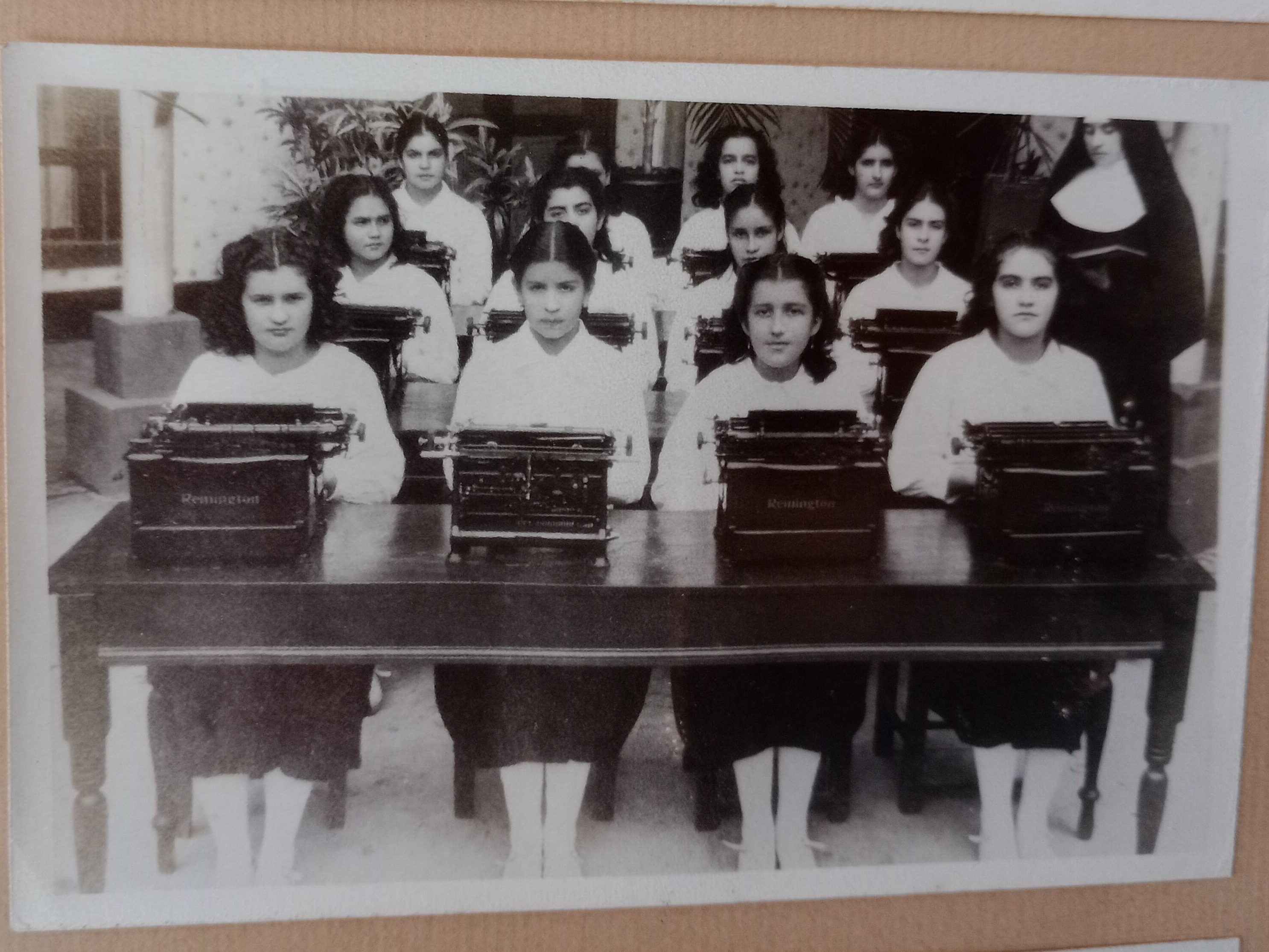
The girls also learned work skills like typing.
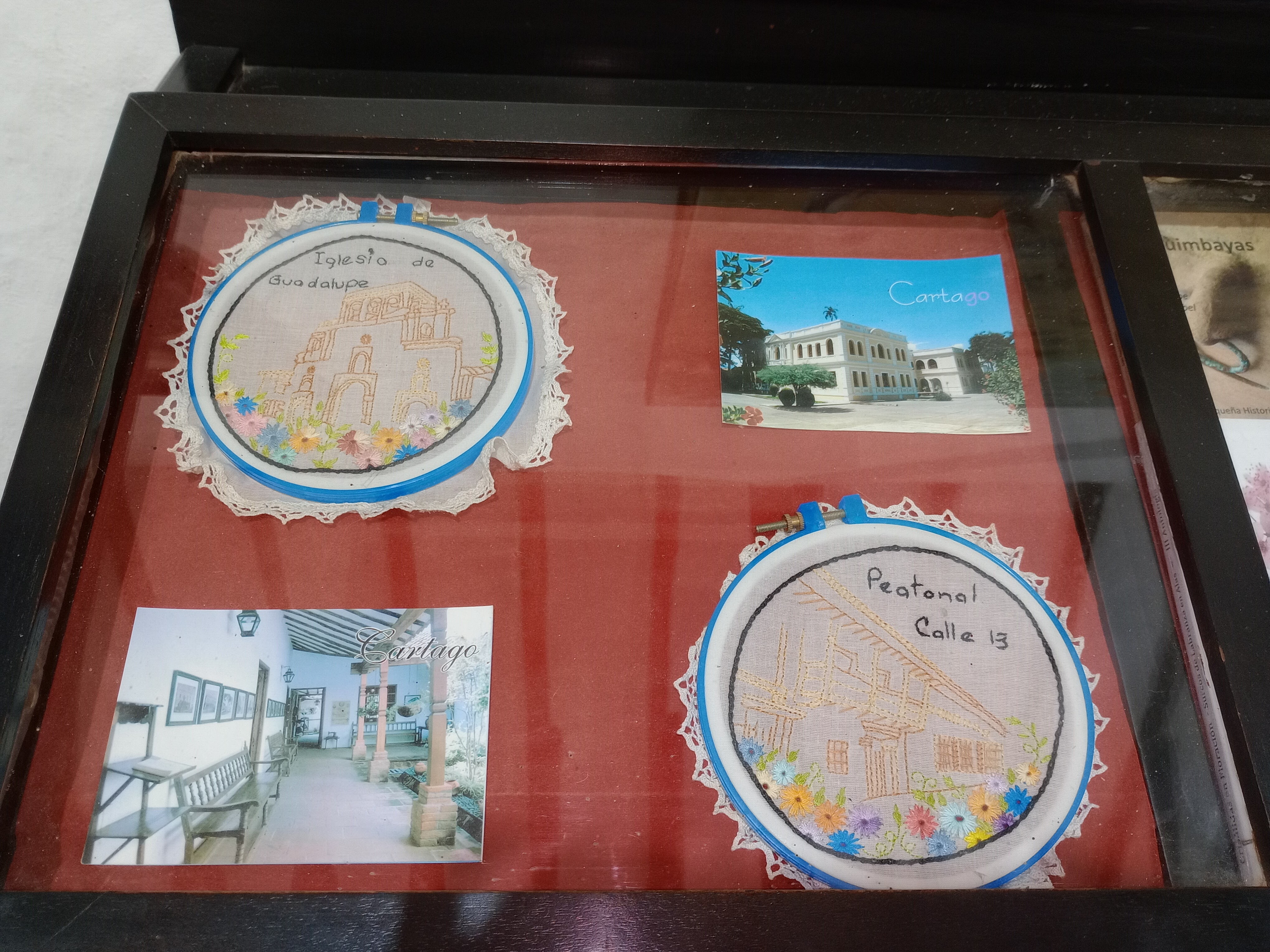
Embroidery is part of Cartago’s identity.
There is a saying in Cartago, Más cartagüeño que un bordado. It means more Carthaginian than an embroidery. It is used to describe someone or something that represents the city’s identity well.
Window, House of the Viceroy.
Cartago was founded on August 9th, 1540. It just turned 483 years old this year (2023.)
It’s been a while since I visited Cartago (since before the pandemic) so it was time.
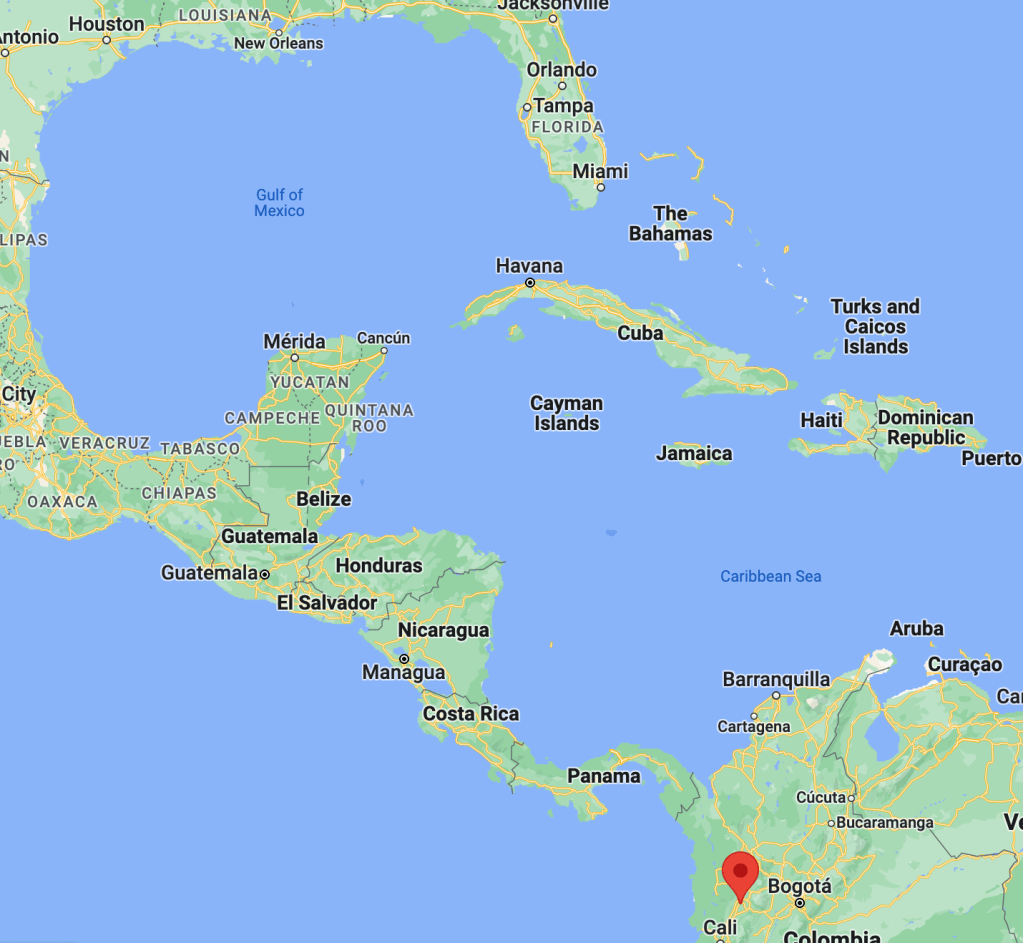
Cartago, in the southwest of Colombia.
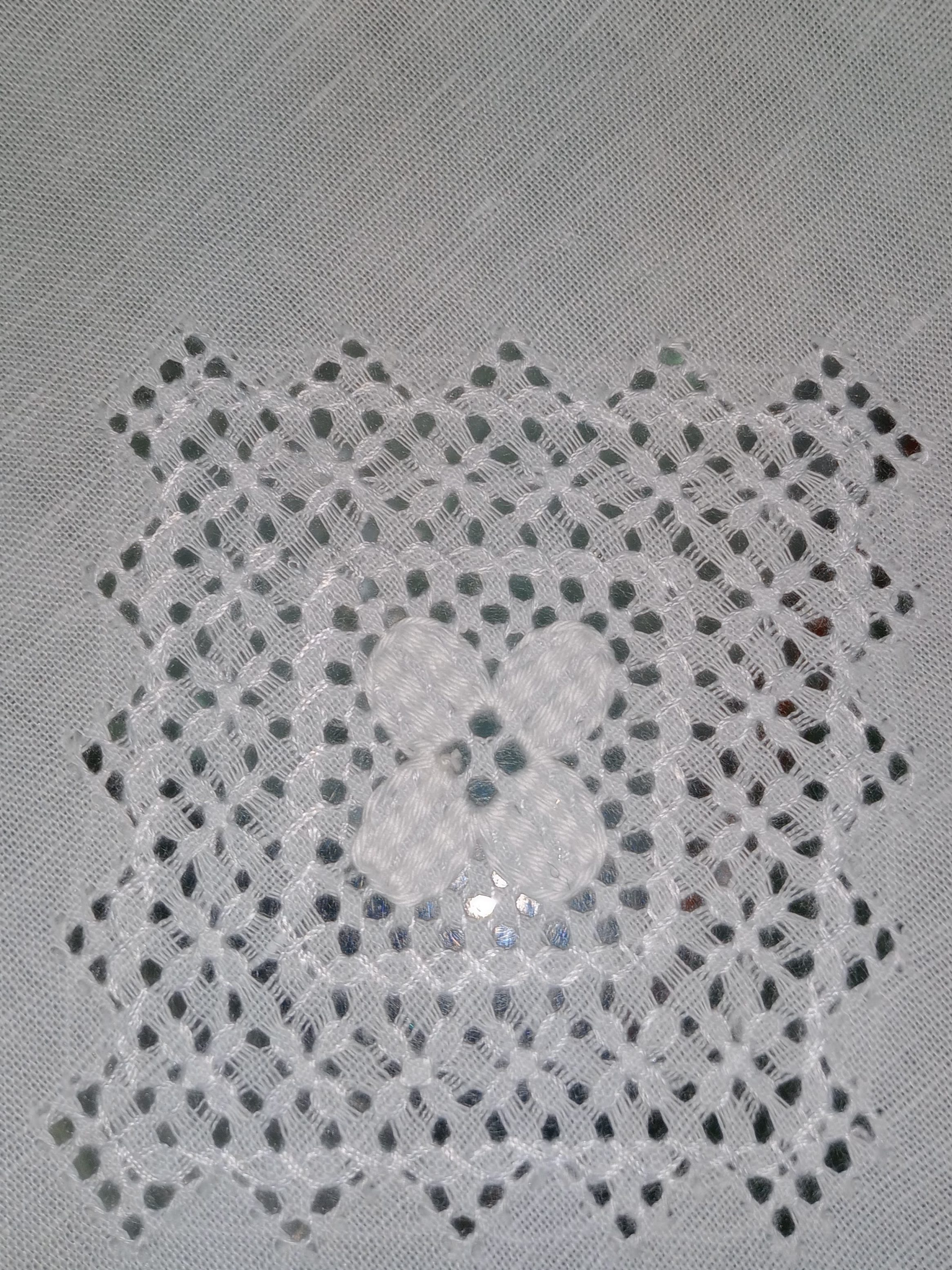
Cartago is a town in southwest Colombia that is considered Colombia’s Embroidery Capital. Cartago’s most traditional style of embroidery is Calado which translates to openwork. Calado is a type of drawn thread embroidery (deshilado) and it also encompasses tape lace (encaje de sesgos.)
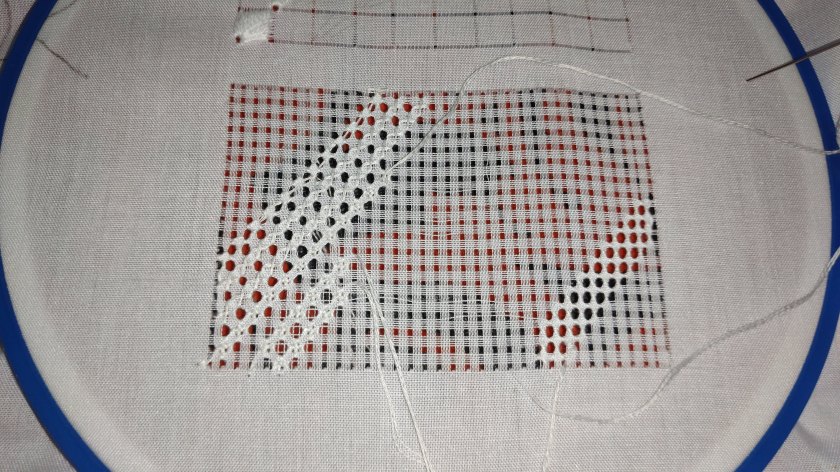
Cartago Openwork/Drawn thread (calado de Cartago.)
The best way to get to Cartago from the US is to fly. There is an American Airlines flight from Miami to Pereira’s Matecaña airport almost every day. From Pereira, ground transportation to Cartago can be arranged; it’s roughly 45 minutes away.
The Wow Company offers very interesting tours so I decided to take two of them:
The artisanal experience (Experiencia artesanal)
The courageous city of Cartago (La valiente ciudad de Cartago)
Artisanal Experience
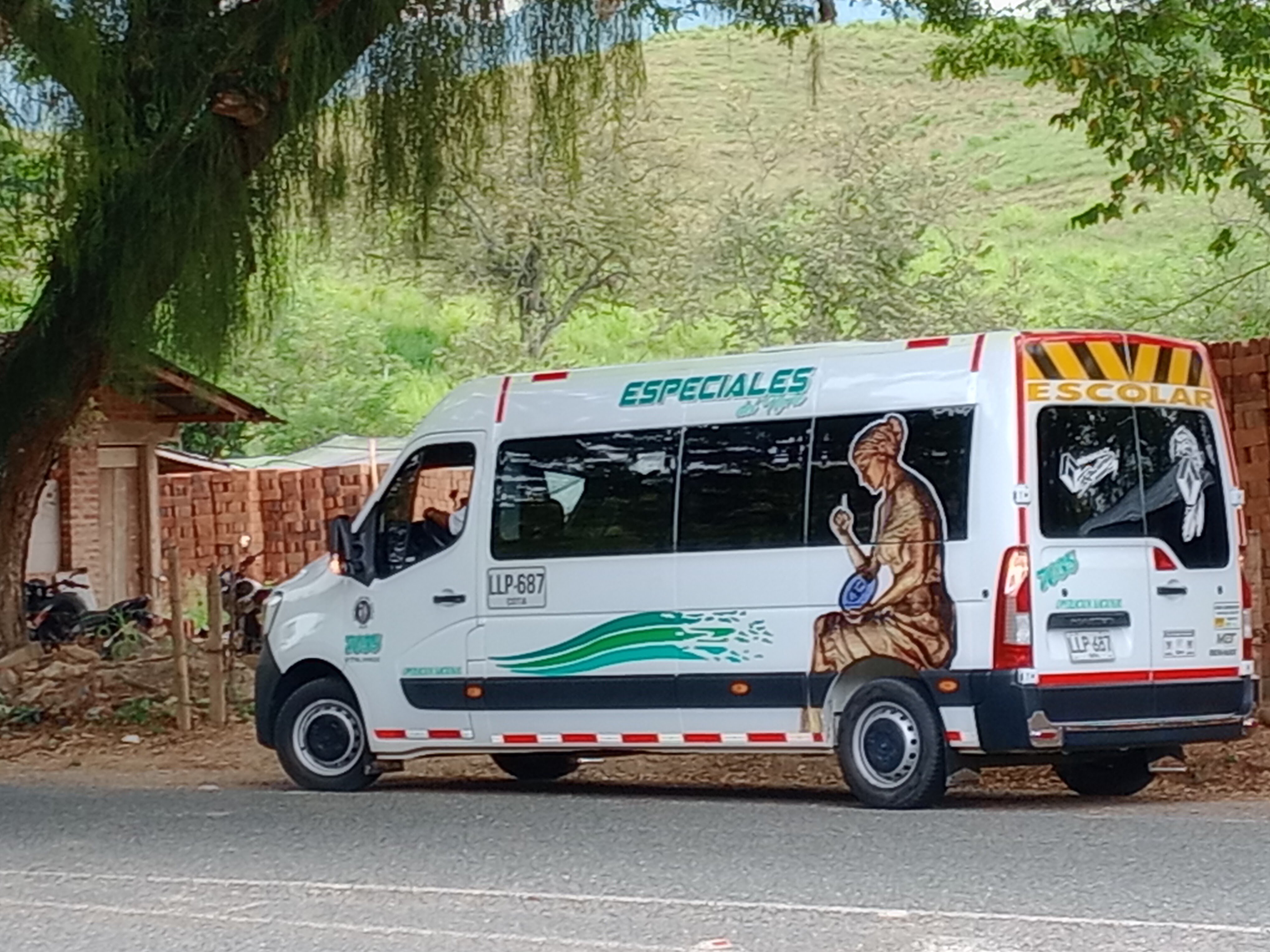
The embroidery tour bus
We were collected in a mini-bus, about 15 of us, bright and early at 8:30 am, and were driven to the nearby town of Ansermanuevo, where most of the embroiderers live.
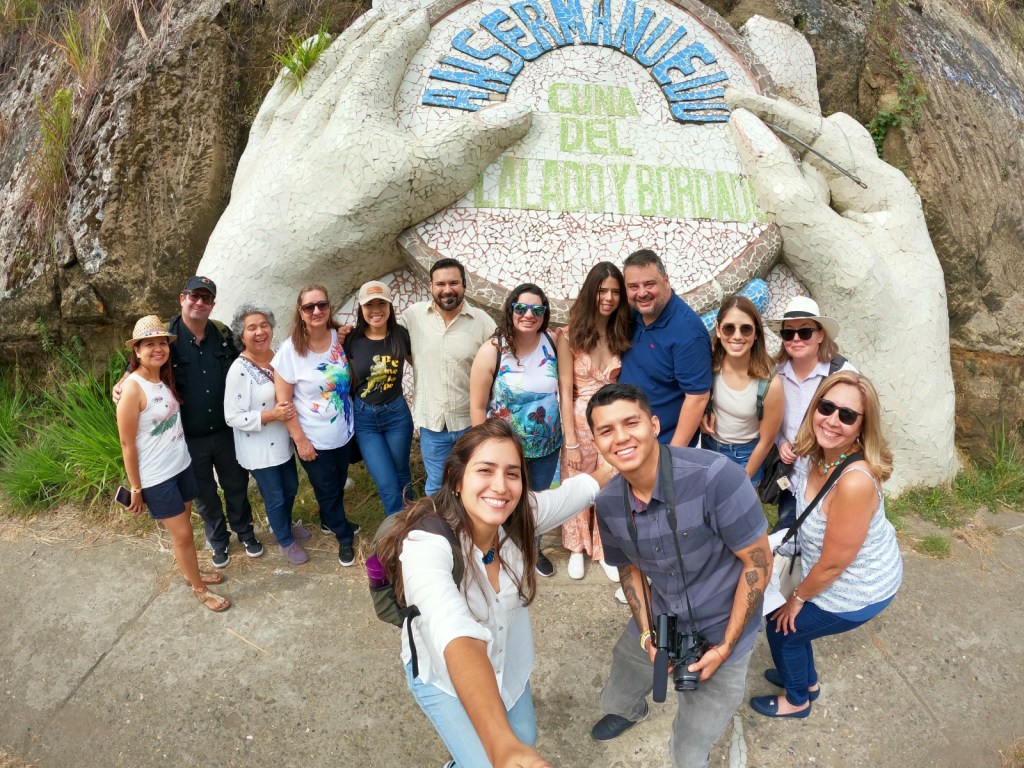
Ansermanuevo, cradle of Drawn thread Embroidery (Cuna del Calado y Bordado.) Sign outside of town: an embroidery frame, hands and a needle.
Ansermanuevo, cradle of Drawn thread Embroidery (Cuna del Calado y Bordado.) Sign outside of town: an embroidery frame, hands and a needle.
Lina Medina explaining Casa Victoria’s mission and teaching us how to draw threads from fabric using a piece of jute.
Casa Victoria is an association by embroiderers, for embroiderers.
Lina told us that the typical embroiderer only makes about $250,000 pesos a month (US $62.50 as of 8/5/2023) from embroidering.
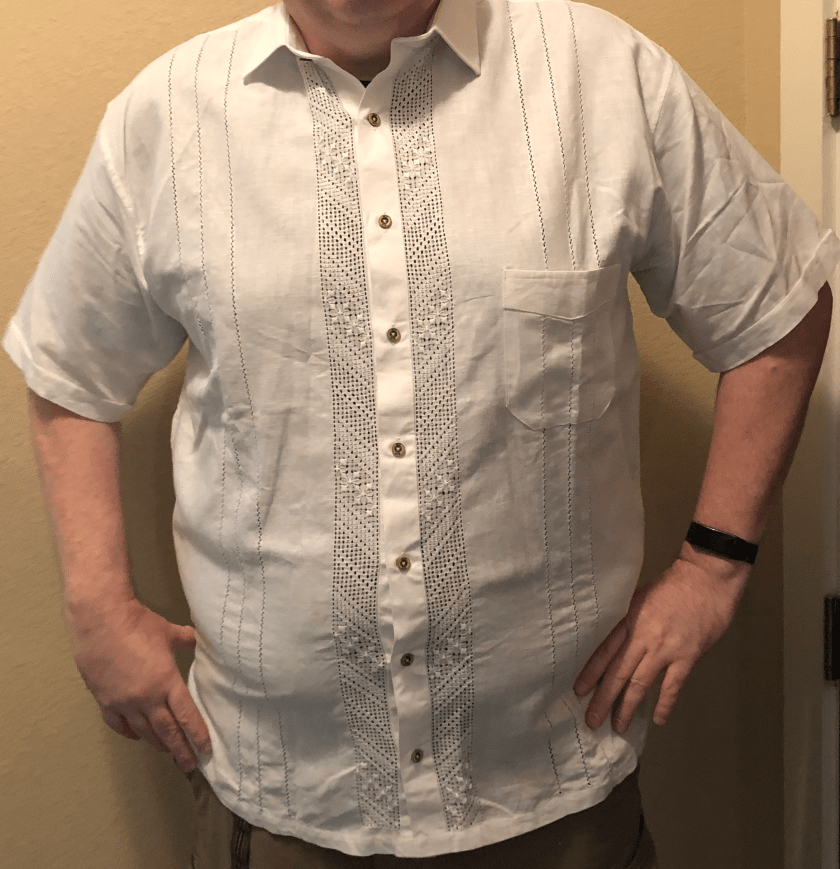
The typical guayabera (Caribbean/Cuban shirt)
The typical guayabera (Caribbean shirt) costs $250,000 pesos at a shop in Cartago. The embroiderer only makes $18,000 pesos for embroidering the side panels (both of them!) of the guayabera. That is three days worth of effort that net the embroiderer only 7.2% of the final cost of the shirt.
Average Embroiderer’s Income
Colombian Pesos
US Dollars
Monthly income
$250,000
$62.50
Income from one embroidered shirt
$18,000
$4.50
Time taken to embroider panels for shirt
3 days
Percentage of sale price that goes to the embroiderer
7.2%
Casa Victoria aims to make sure their embroiderers get paid at least $30,000 pesos (US $7.50) per shirt.
Learning to draw threads from a piece of jute fabric.
Ansermanuevo Culture House
The next stop was at the Ansermanuevo’s Culture House.
Carolina Restrepo at the Ansermanuevo Culture House.
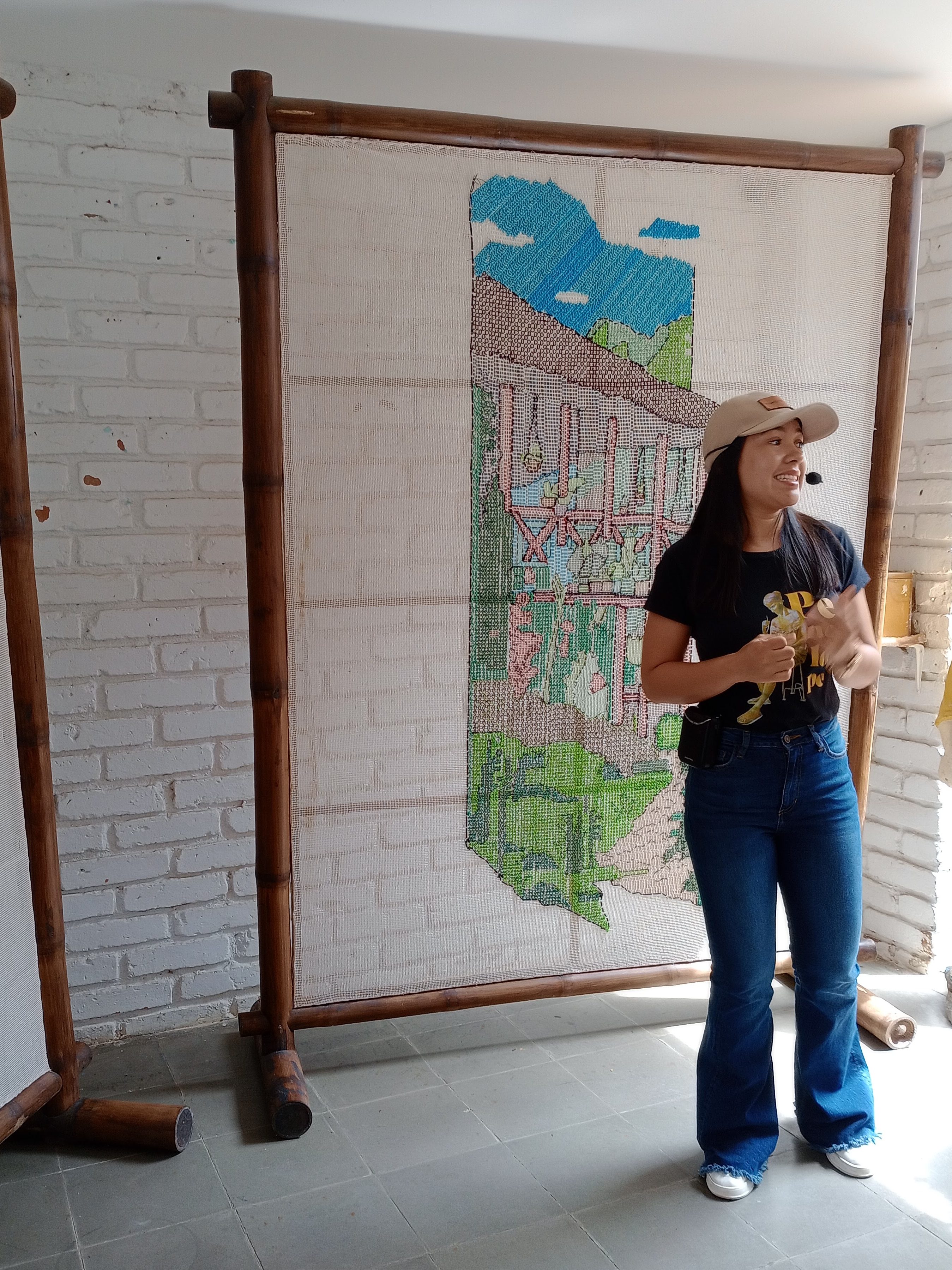
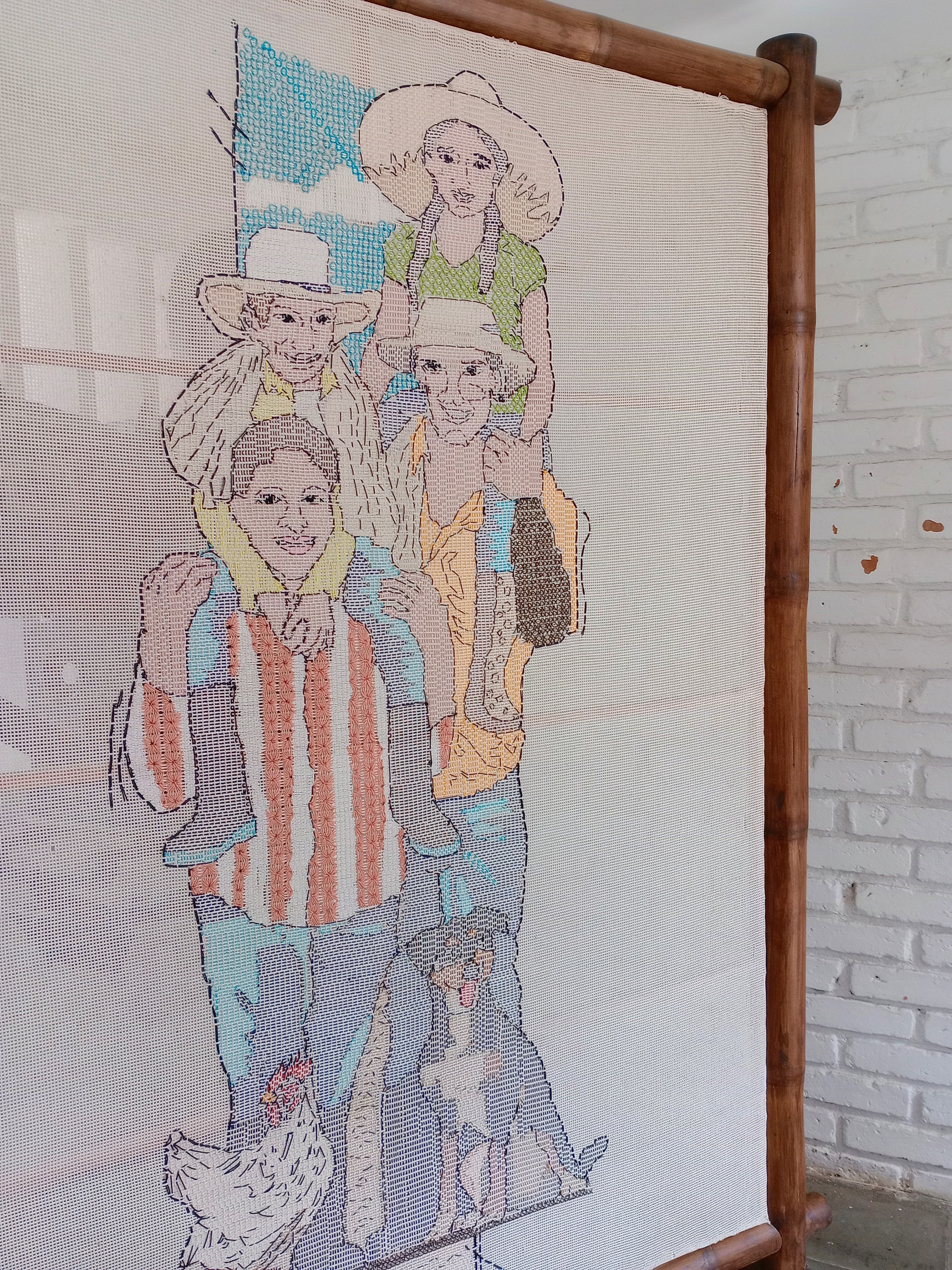
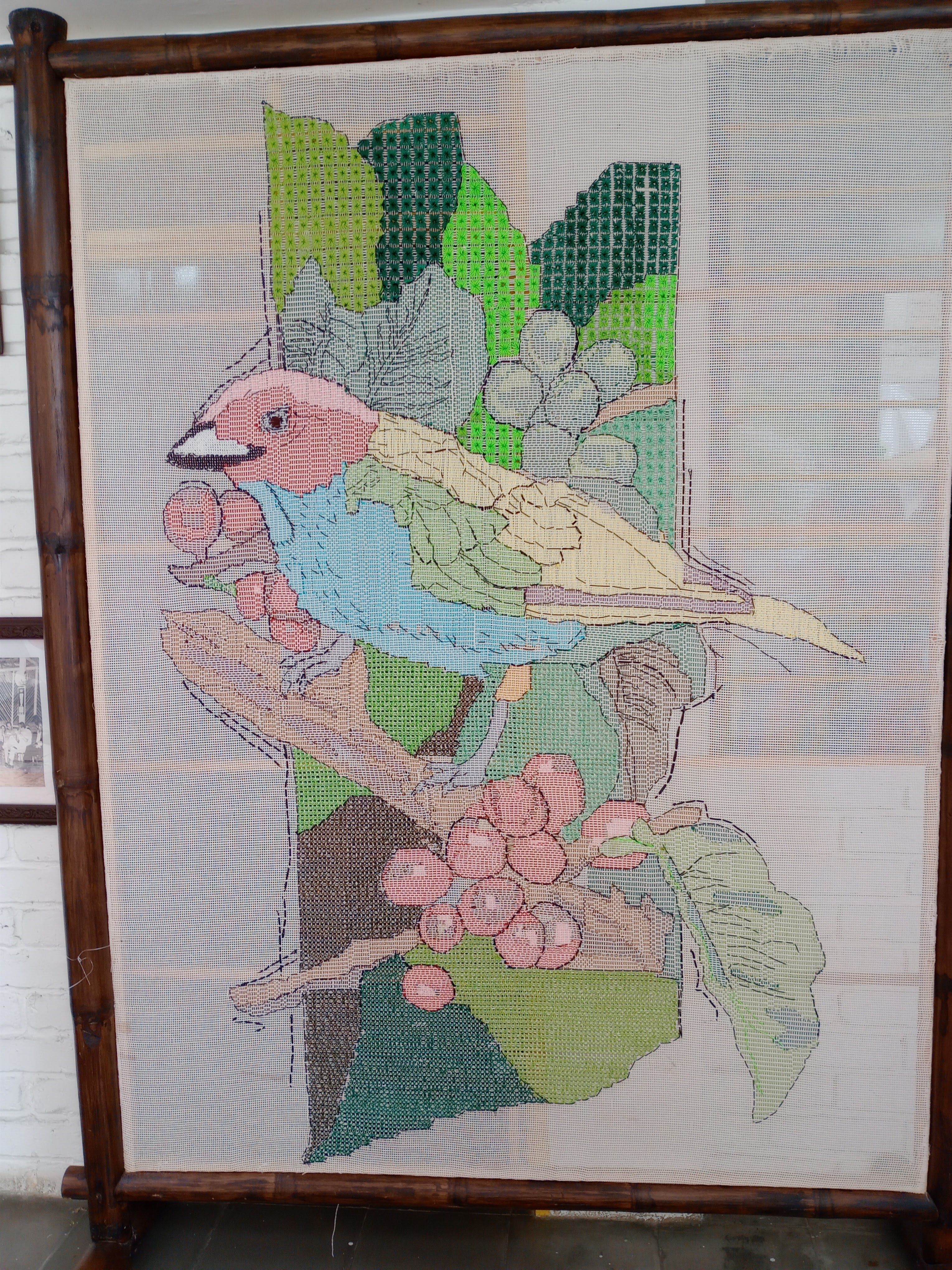
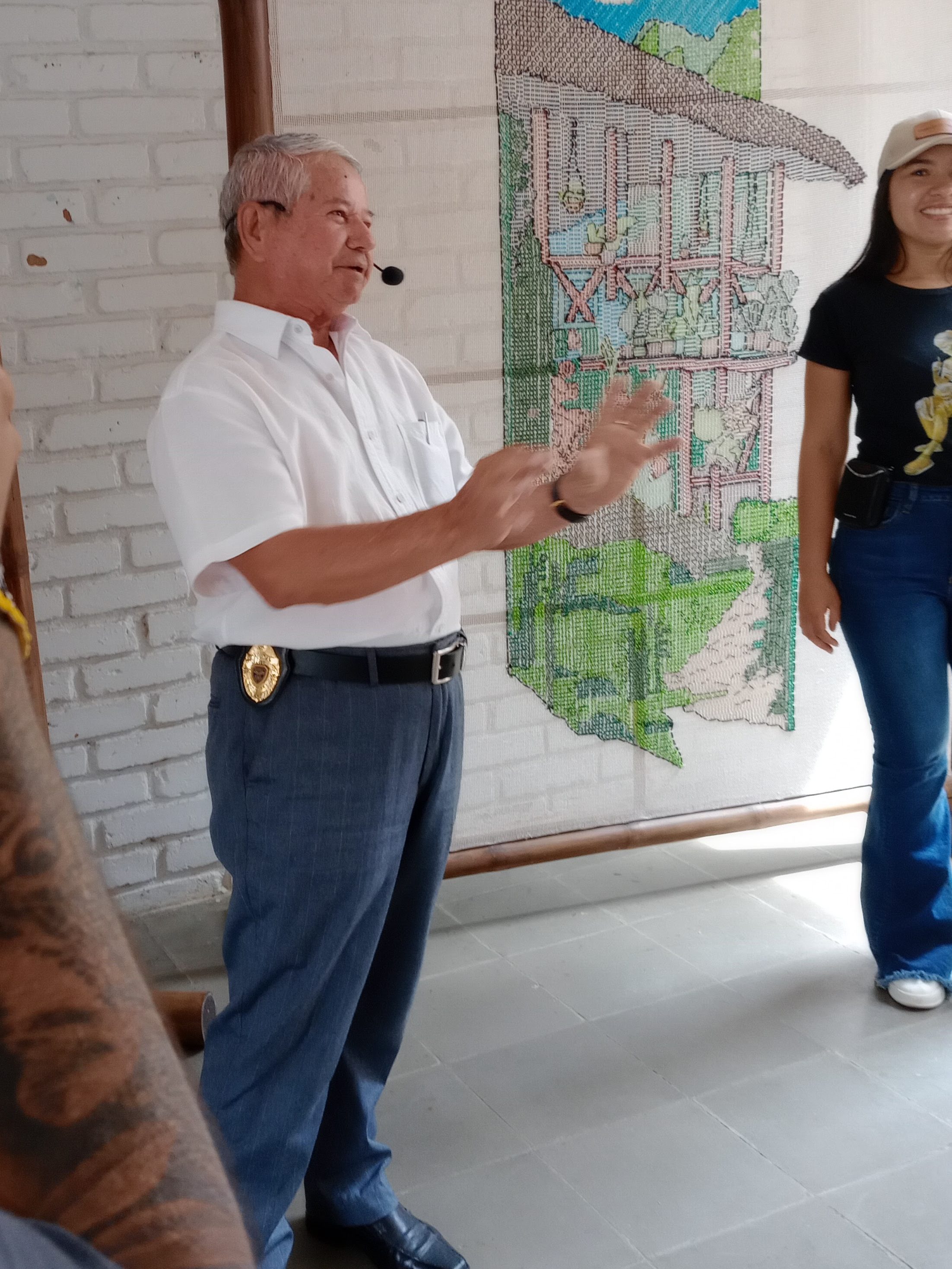
Carolina Restrepo told us about her work teaching the local children to embroider and make embroidered murals on chicken wire.
Given how poorly paid the embroiderers are, many mothers do not encourage their children to learn. Carolina wants to make sure the next generation does not stop embroidering. This is their town’s tradition, and even if they choose not to pursue it as a source of income, they could still practice it as a traditional pastime and artistic endeavour.
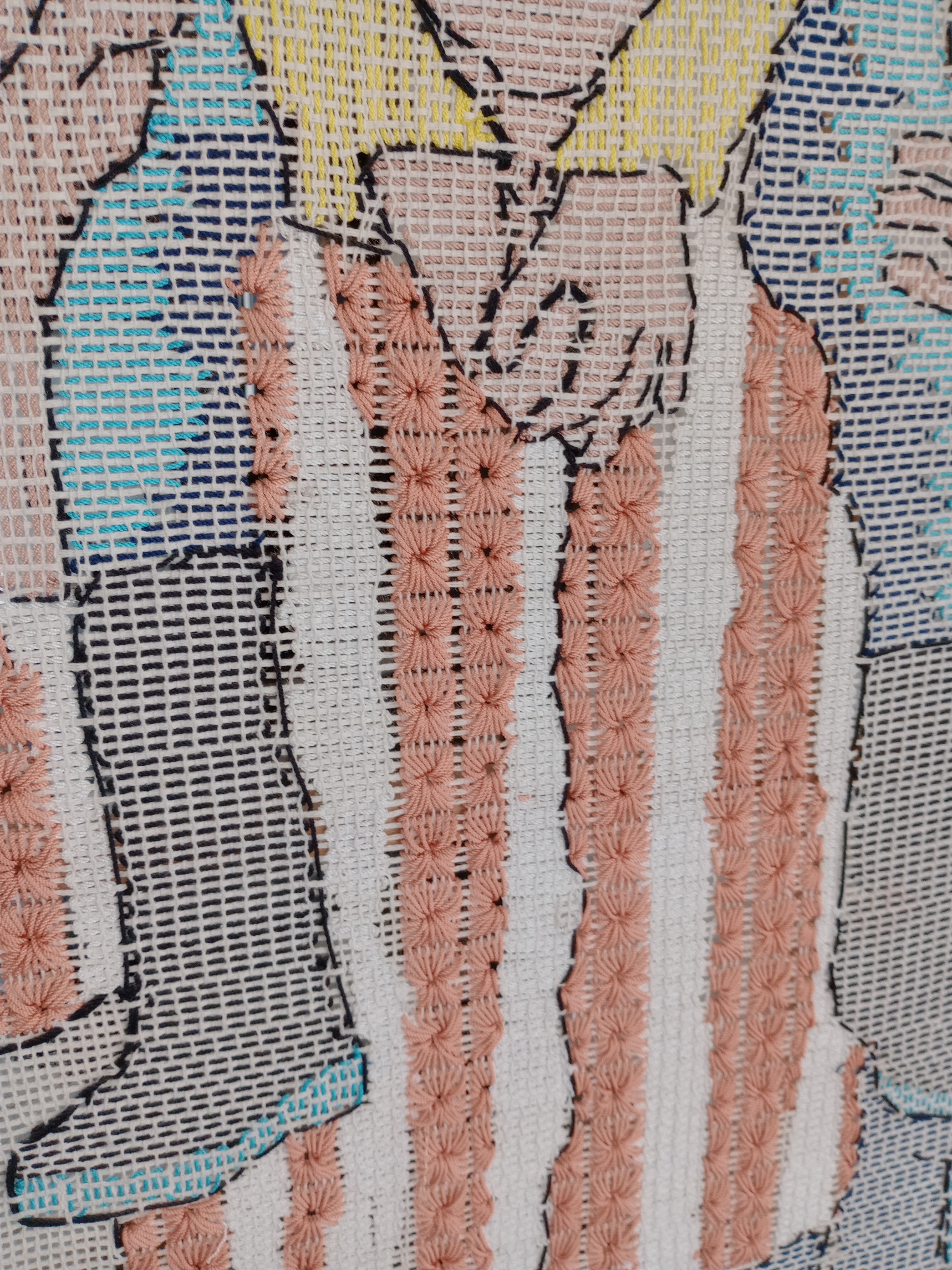
Embroidered murals on chicken wire.
Close-up of one of the embroidered murals
Embroidered mural of a local bird, a troupial (Icterus icterus), on a coffee plant.
Captain Córdoba, from the local fire department, regaling us with his poems about Ansermanuevo and its embroiderers.
Calado Lesson at Fatima School
The next stop was at the Fatima parish school for a lesson in embroidery history.
Embroidery was introduced to the region by the Vicentine and Franciscan religious communities in the late 1800s (19th) century when they arrived to open schools for girls.
The sisters made sewing part of the curriculum. Calado (drawn thread) was part of the course so they could make household and church linens.
With time, the Cartago and Ansermanuevo women developed a unique style which was then sold to others outside their households.
Calado lesson
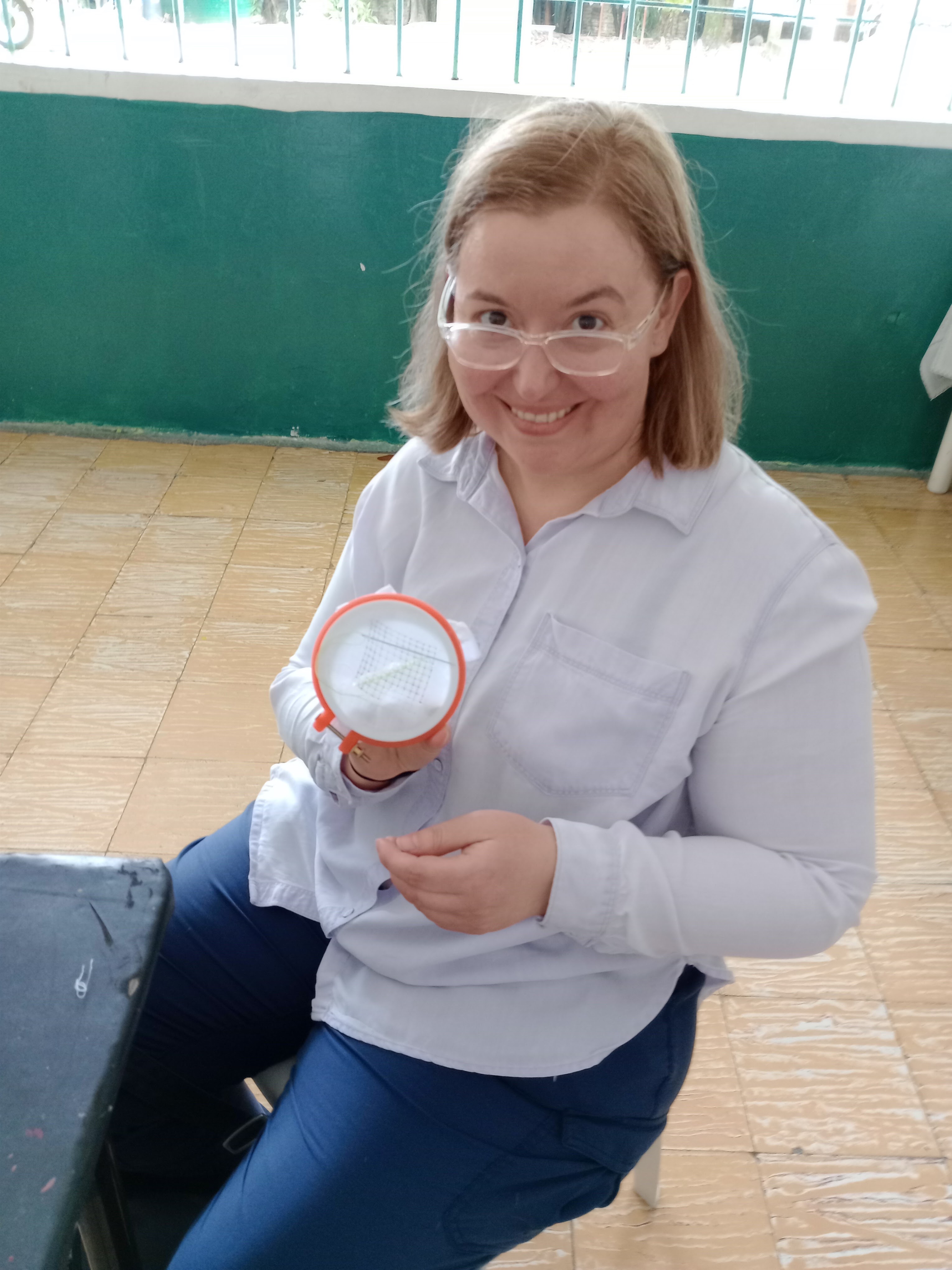
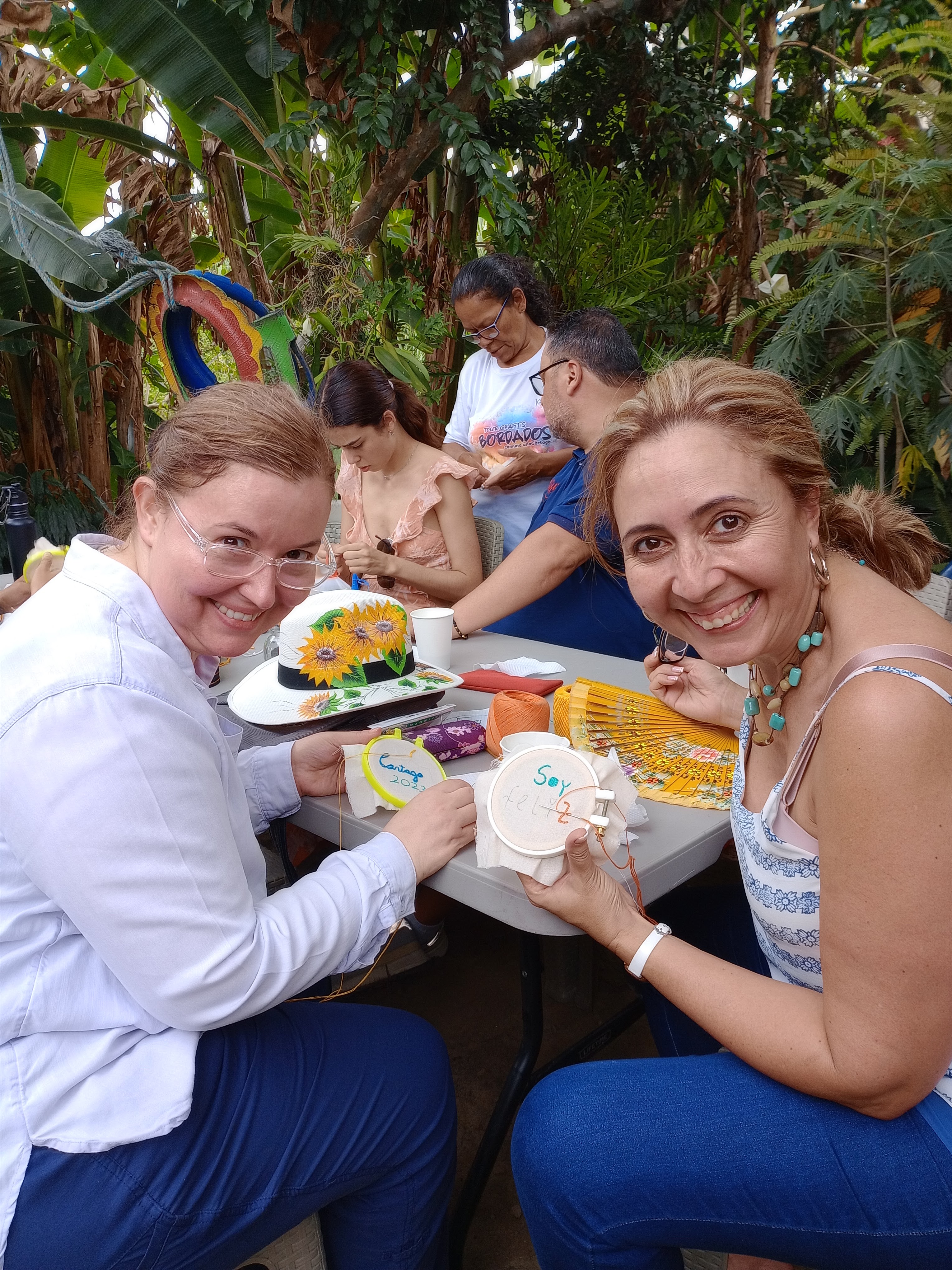
We were taken to a classroom with embroidery frames containing fabric with the threads already removed forming a grid. We were taught some basic stitches (grid and cross.) We were given very nice coffee and snacks.
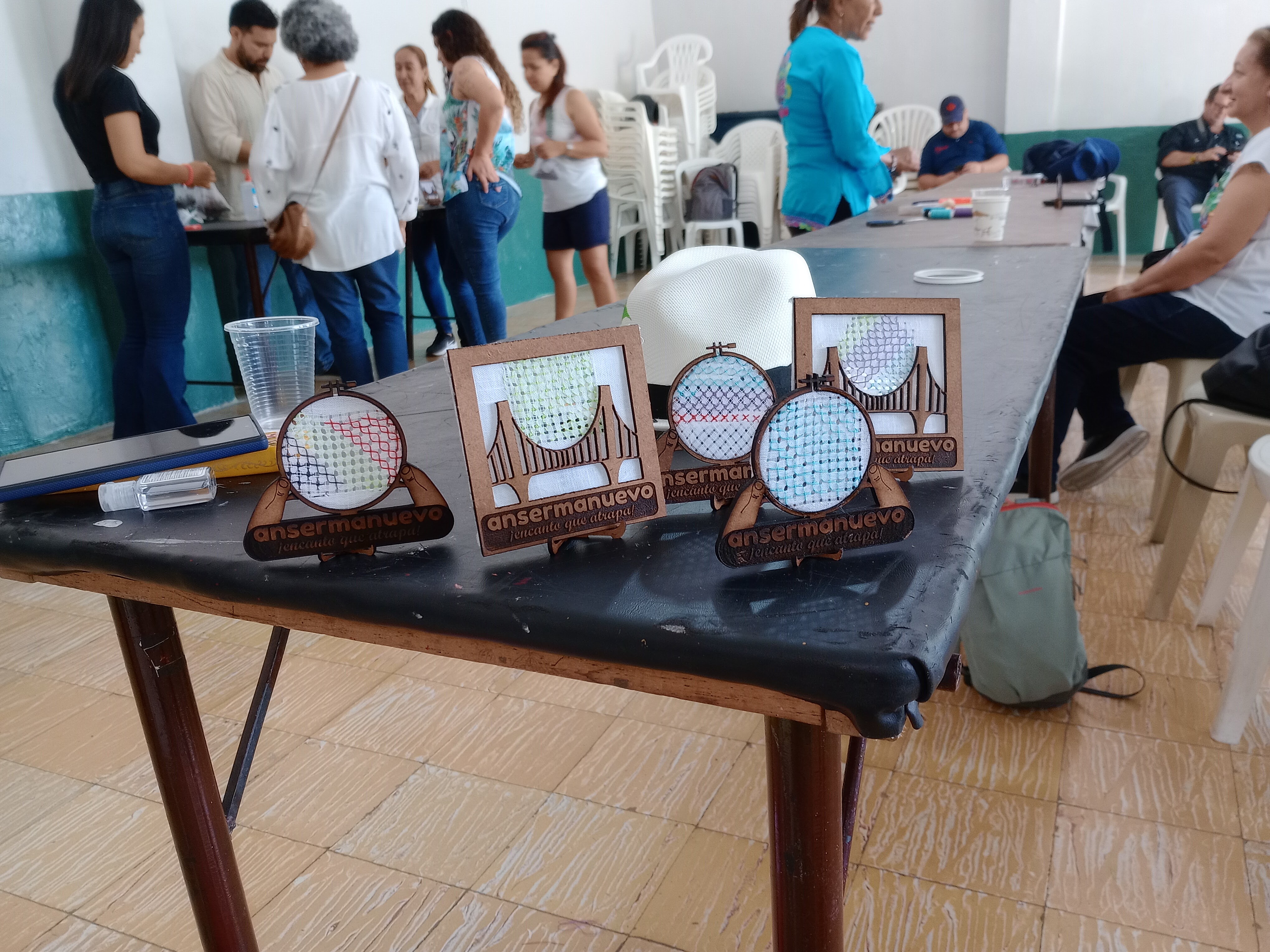
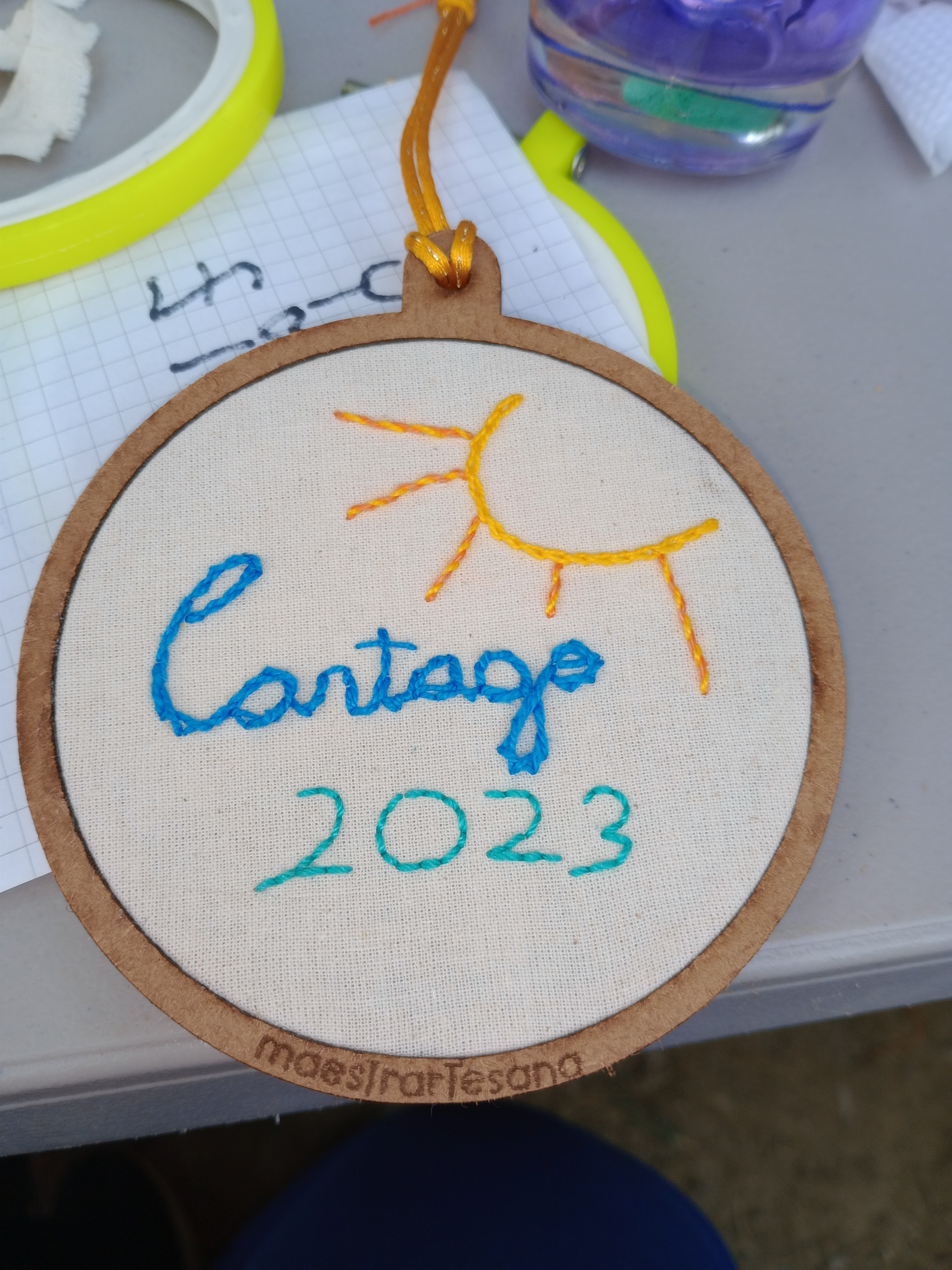
My calado effort was put into an ornament. Great souvenir.
Class members’ finished ornaments.
Back to Cartago and Lunch
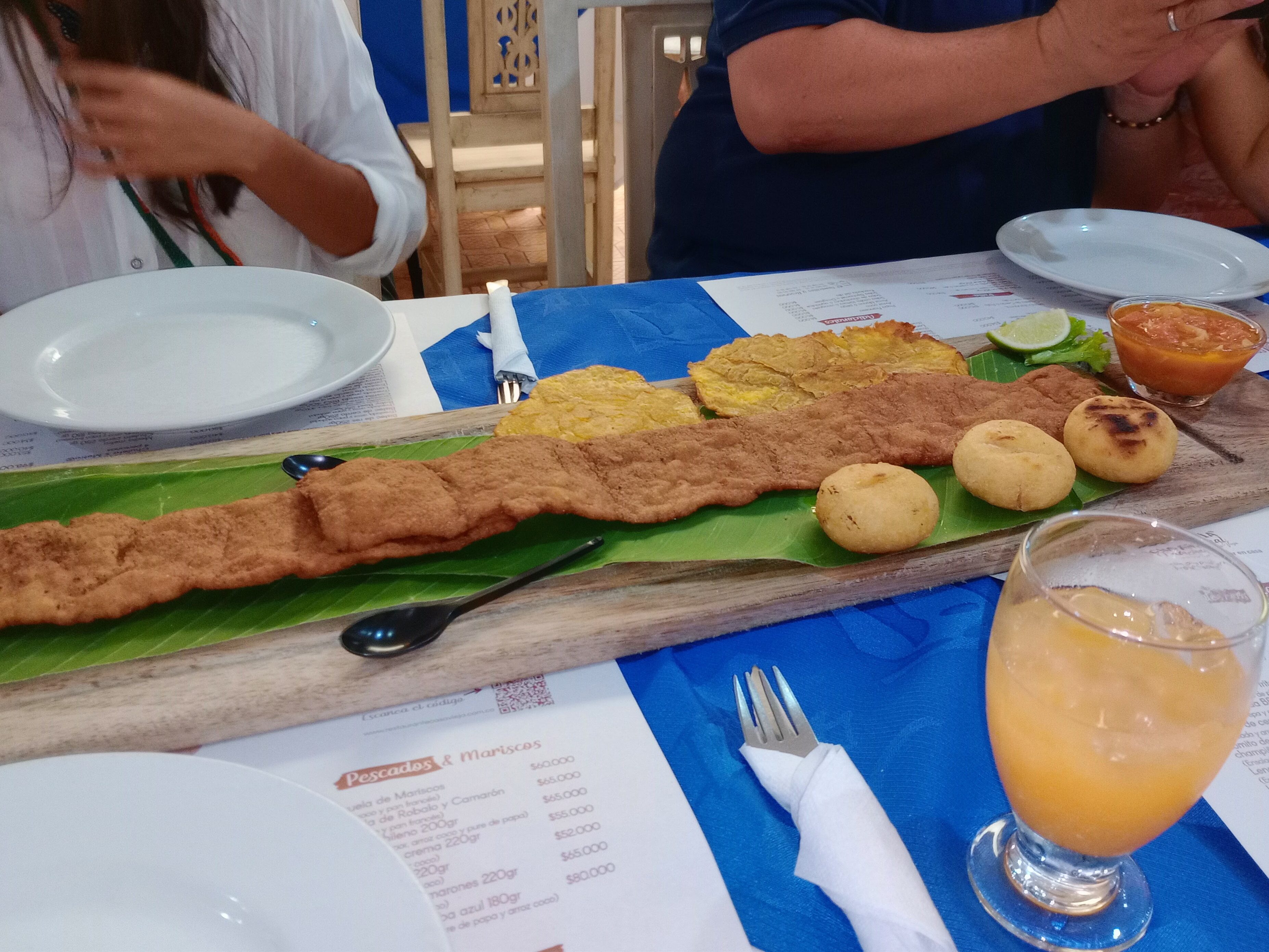
We were then driven back to Cartago in the embroidery bus and taken to Casa Vieja restaurant where the specialty is pork cutlet by the meter (three feet.)
Cutlet by the meter (chuleta por metro) at Casa Vieja in Cartago.
Visiting Penelope
We went to visit Penelope next.
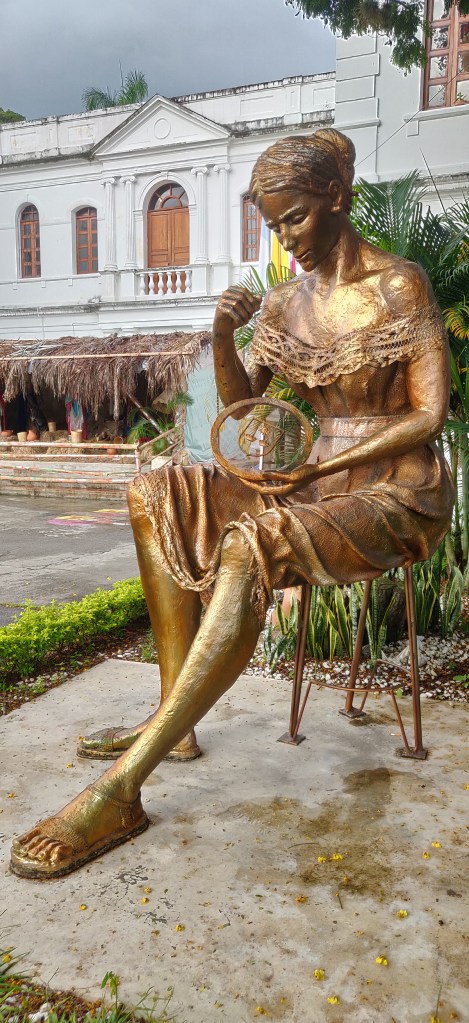
Penelope is the name given to the statue made by Carlos Tulio Suarez and Margarita Gamboa (the tape lace) to honor Cartago’s embroiderers. She resides in front of city hall.
Monument to the Embroiderer
Her name comes from the character in Homer’s Odyssey. The queen of Ithaca would weave during the day and undo her work at night in order to delay having to marry one of the many suitors requesting her hand thinking her husband dead.
Embroidered Graffitis
On to the Comuna One, commonly called the Sandpit (la Arenera.) This working class neighborhood was founded by sand extractors (sand to be used for construction) and embroiderers.
Embroidered Graffitis Tour
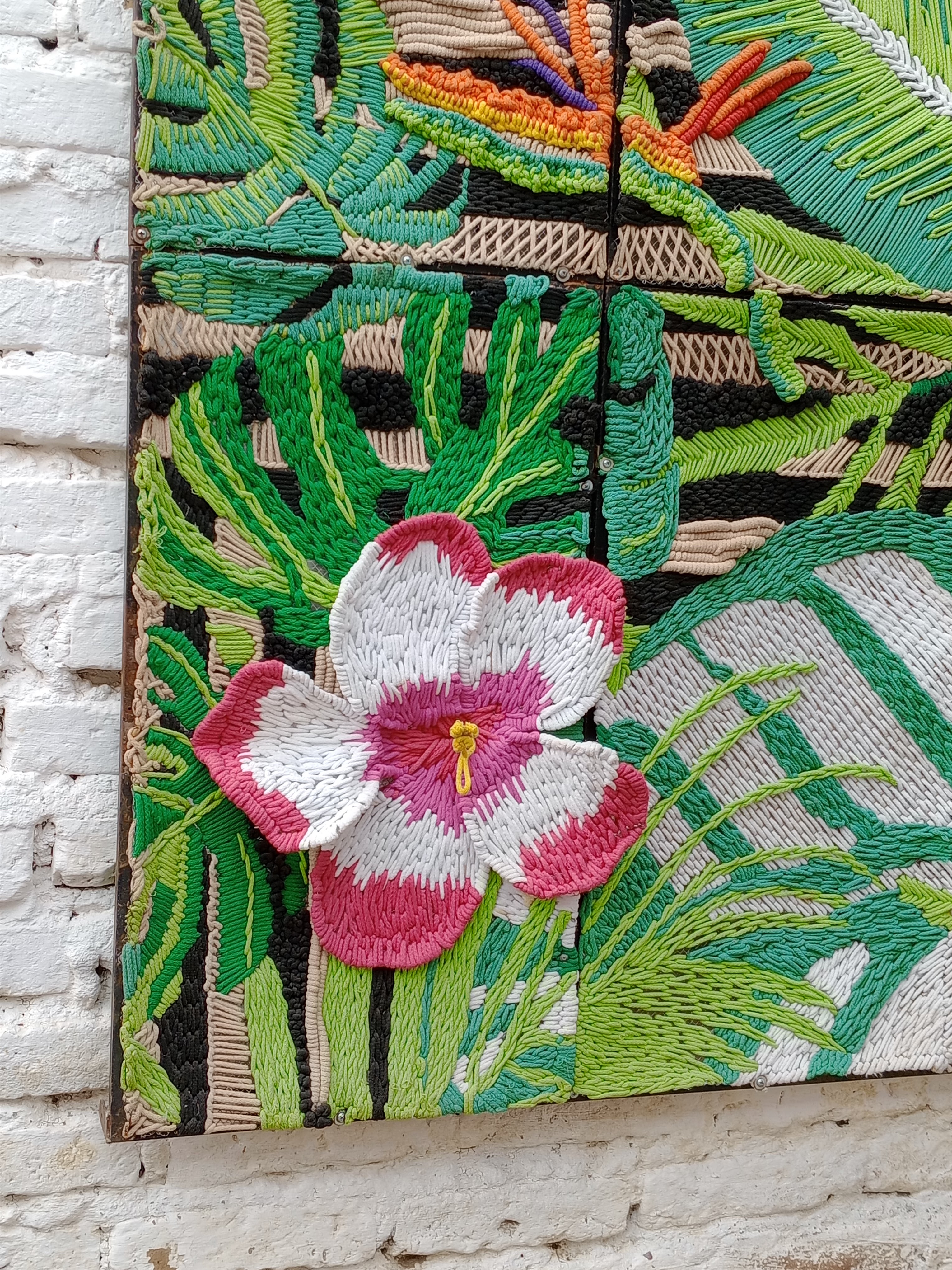
Carolina Restrepo took us through the streets and showed us the embroidered graffitis made by the neighborhood’s children.
Embroidered graffiti with a stumpwork flower.
Tribute to Leo Graff
One of the big graffitis is a tribute to local musician Leo Graff. One of his songs celebrates the culture of the Arenera neighborhood by mentioning that in every house there is at least one embroiderer (en todas las casas por lo menos una borda.)
After his death, his son made a music video of his song, Arenera, showing the local embroiderers.
Music video by Leo Graff’s son – tribute to the Arenera neighborhood.
Another embroidered graffiti.
Surface Embroidery Class
We then went to Nancy Zúñiga’s house (Carolina Restrepo’s mother) for a class on surface embroidery.
Her house is by the river with lots of plants. We were offered coffee and snacks.
Surface embroidery class at Nancy Zúñiga’s house
My project turned into an ornament.
The embroidery tour was great! We learned a lot about the history of the area, its embroidery culture and the embroiderers. It was very well organized and safe.
It is definitely geared towards textile newbies. One person did not know the difference between weaving and embroidery and he walked away with self-made projects using drawn thread (calado) and surface embroidery.
But seasoned embroiderers will enjoy the history and the embroidery culture. There are references to embroidery everywhere in both towns. In the embroidered graffitis tour, a lady opened her door as we were passing by and we saw her embroidering a shirt. We said hi to her and her dog and she sold us yummy fruit ice creams. Mine was lulo fruit (Solanum quitoense.)
I’m a member of the EGA (Embroiderers’ Guild of America) and I attended 2022’s National Seminar in New York City.
EGA’s 2022 National Seminar.Mercedes seeing the samplers for the first time in three years.
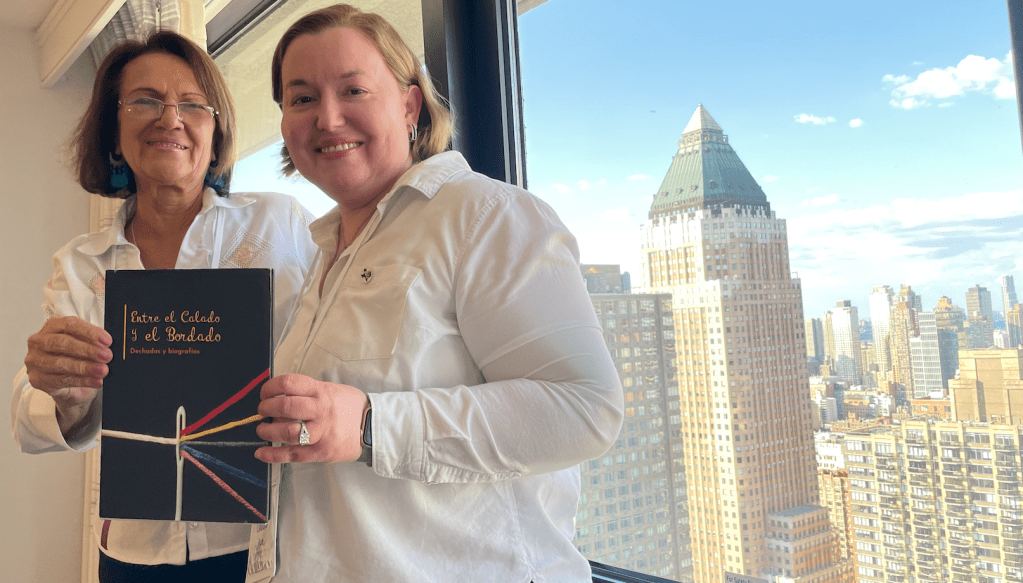
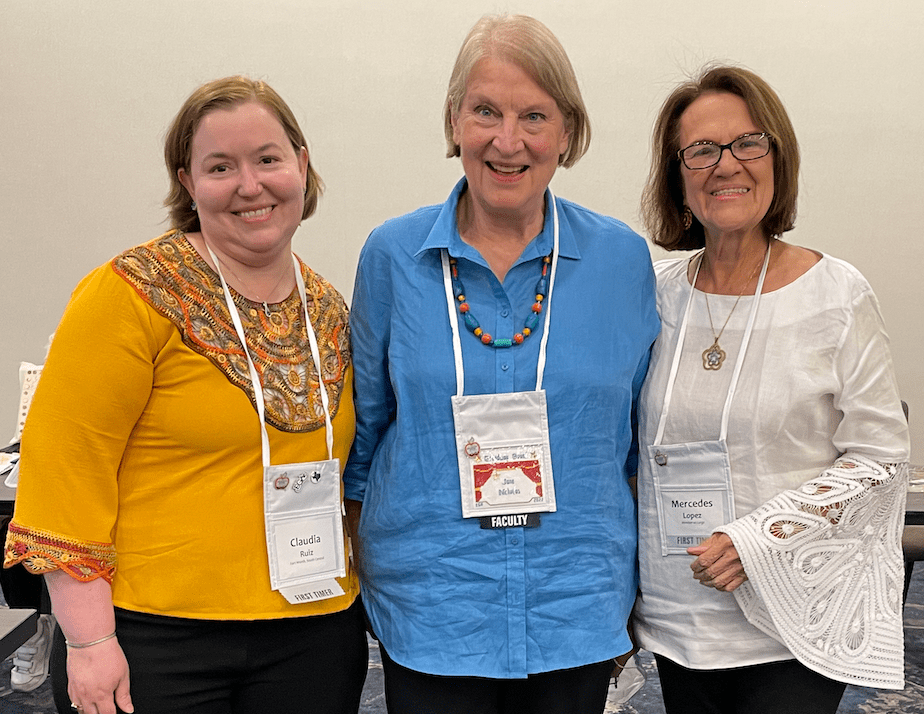
At the seminar I met up my dear cousin Sandra that lives in Florida and is an EGA Member-at-Large and my Calado de Cartago teacher, Mercedes Lopez.
Mercedes has been teaching me Calado de Cartago (Cartago openwork or drawn thread work-see here for more info) via WhatsApp for the past three years. This was the first time in those three years that we’ve been able to see each other.
Mercedes gave me a book profiling different embroiderers from Cartago by Lina Rodríguez
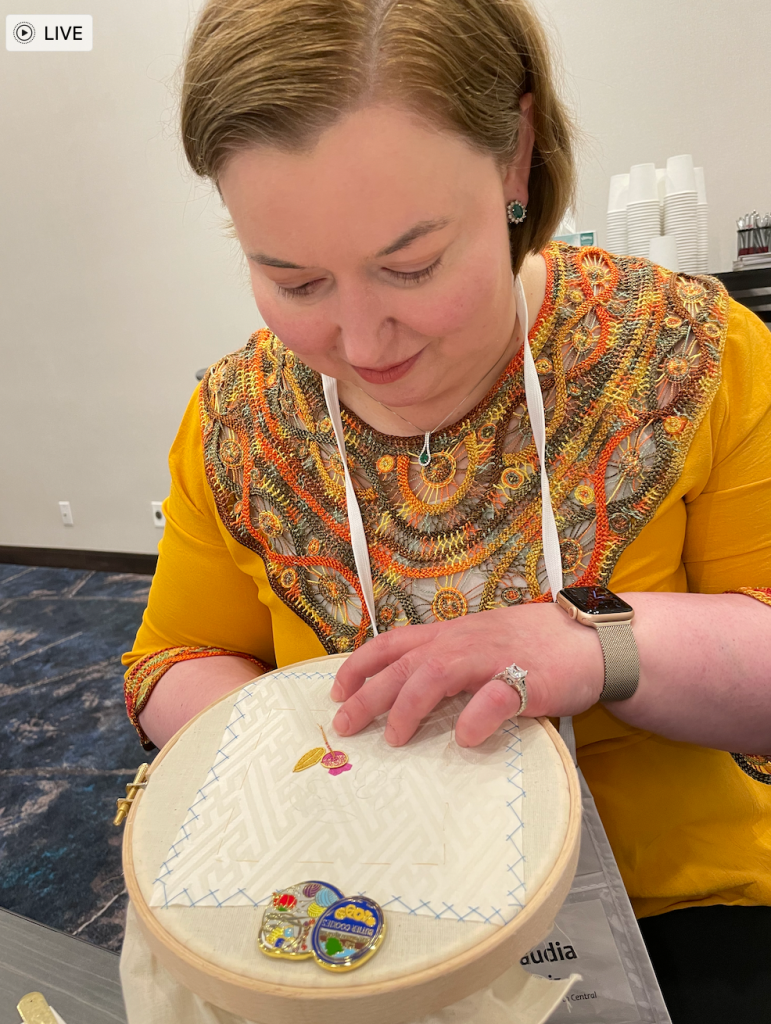
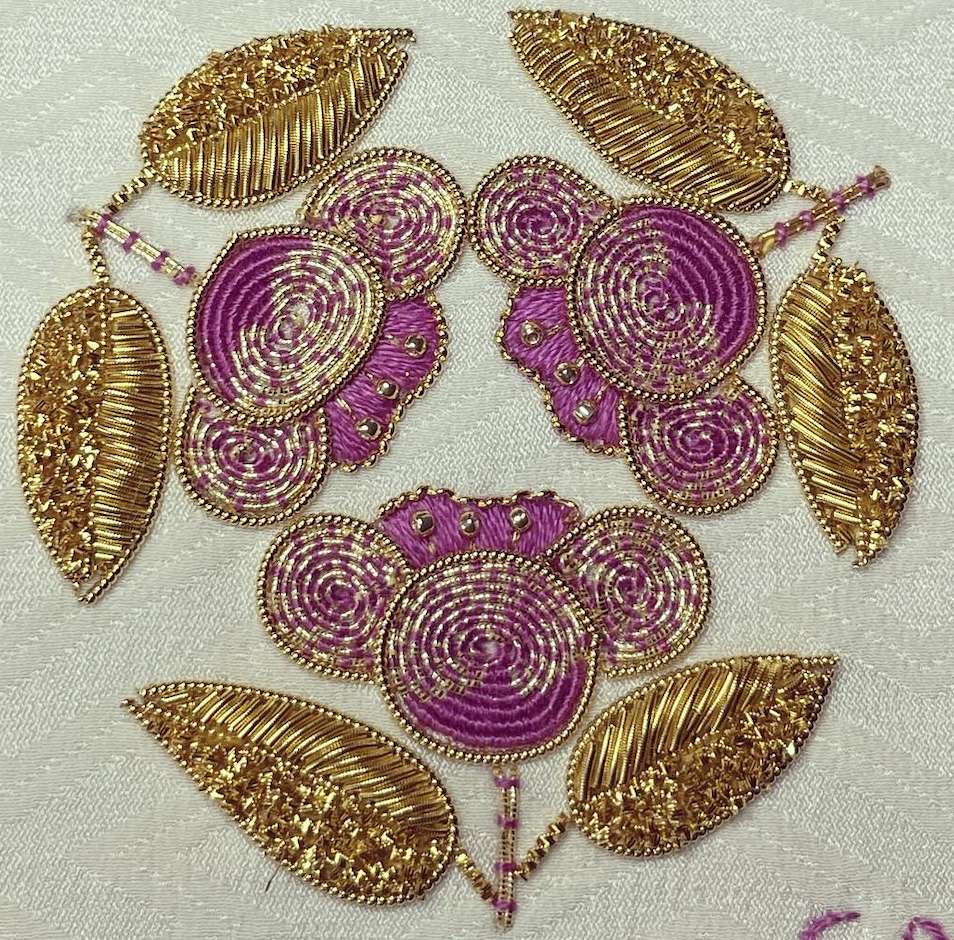
During the Seminar we took a class with Jane Nicholas, her Japanese Cherry Blossoms. They were a motive of three cherry blossoms in goldwork.
Here I am working on the Japanese Cherry Blossoms by Jane NicholasMyself, Jane Nicholas, and Mercedes
It was a great time, catching up with friends who live far away, learning new things and meeting new stitchy friends.
Soy miembro del EGA (Embroiderers’ Guild of America – Gremio de Bordadores de América) y asistí al congreso nacional del 2022 en la ciudad de Nueva York.
Congreso nacional del EGA del 2022La primera vez en tres años que Mercedes ve mi muestrario de calado
El congreso fue la ocasión para verme con mi querida prima Sandra que vive en la Florida y es también miembro del EGA y con mi profesora de Calado de Cartago, Mercedes López.
Durante los últimos tres años, Mercedes me ha estado enseñando Calado de Cartago (para más información) via WhatsApp. Esta fue la primera vez en tres años que nos hemos podido ver.
Mercedes me dió un libro con entrevistas a bordadores de Cartago por Lina Rodríguez
Durante el congreso tomamos una clase con la bordadora australiana Jane Nicholas, sus azahares de ciruela japoneses. Fue un motivo de tres azahares de ciruela hechos en la técnica de bordado en oro.
Aquí estoy bordando un azahar de ciruela japonés de Jane NicholasEl burro por delante, Jane Nicholas y Mercedes
Lo pasamos muy sabroso haciendo visita con viejas amigas, conociendo nuevas y aprendiendo cosas nuevas.
To celebrate, we are going to talk about Colombian embroidery.
In Colombia, weaving/knitting is king (cotton, wool, Gynerium sagittatum, Furcraea, banana fiber, etc.) but embroidery is also appreciated.
Cartago Openwork
Let’s start with the most locally famous, Cartago (Valle del Cauca) openwork.
Penelope, the monument to the embroiderer, Cartago, Valle del Cauca, Colombia.
It is a type of drawnthread whitework. It is done on linen or cotton, but always evenweave. The threads of the ground fabric are drawn (cut) out and then new threads (cotton) are needlewoven in to create beautiful geometric designs on the bias.
Cartago openwork in progress.
The embroidery is used to decorate sheets, tablecloths, curtains, and the famous openwork guayaberas (Panama shirts.)
Openwork Guayabera
Fonquetá Crewelwork
In the highlands of the Cundinamarca state, sheep are raised, and with their wool, fabric is woven and embroidered.
Crewelwork from the Fonquetá artisanal workshop (@tallerartesanalfonqueta)
Nariño Appliqué
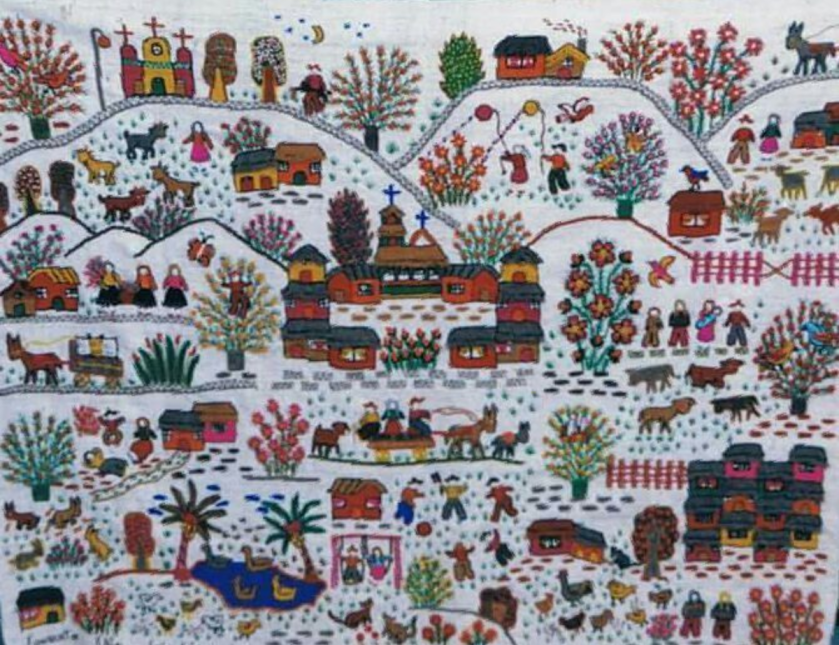
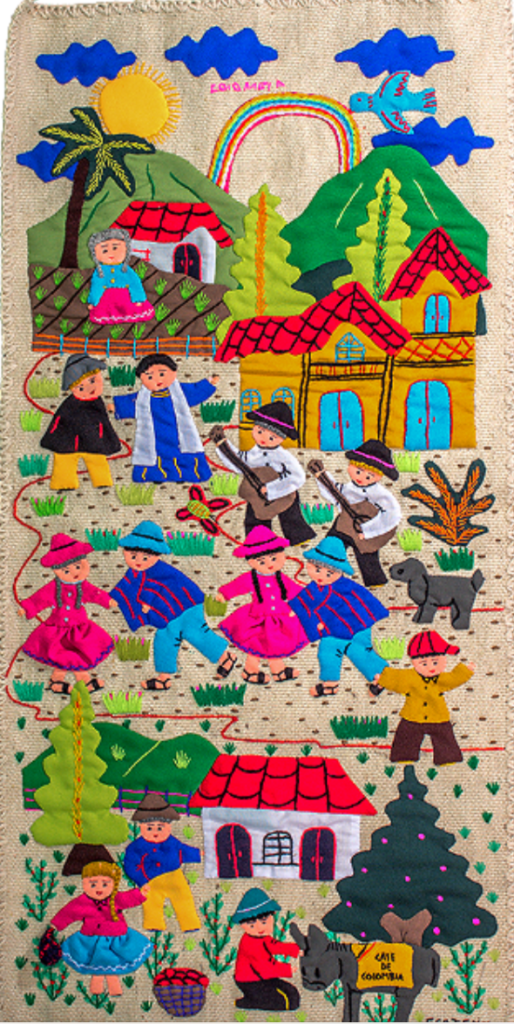
In the city of Pasto, Nariño, they weave woolen blankets which they then embroider with appliqué using cotton fabric and threads.
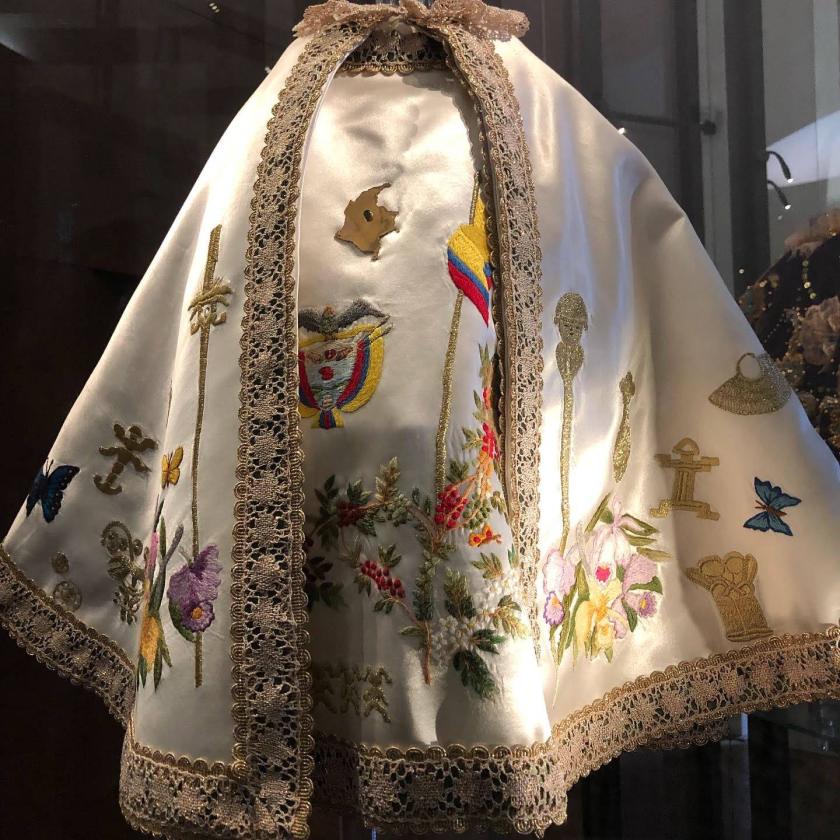
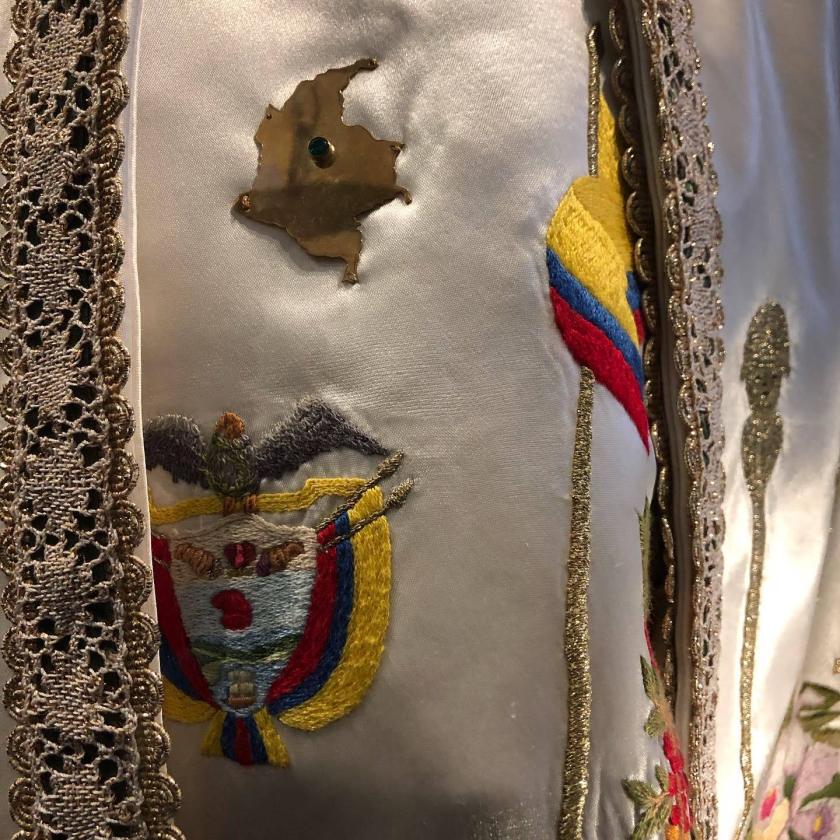
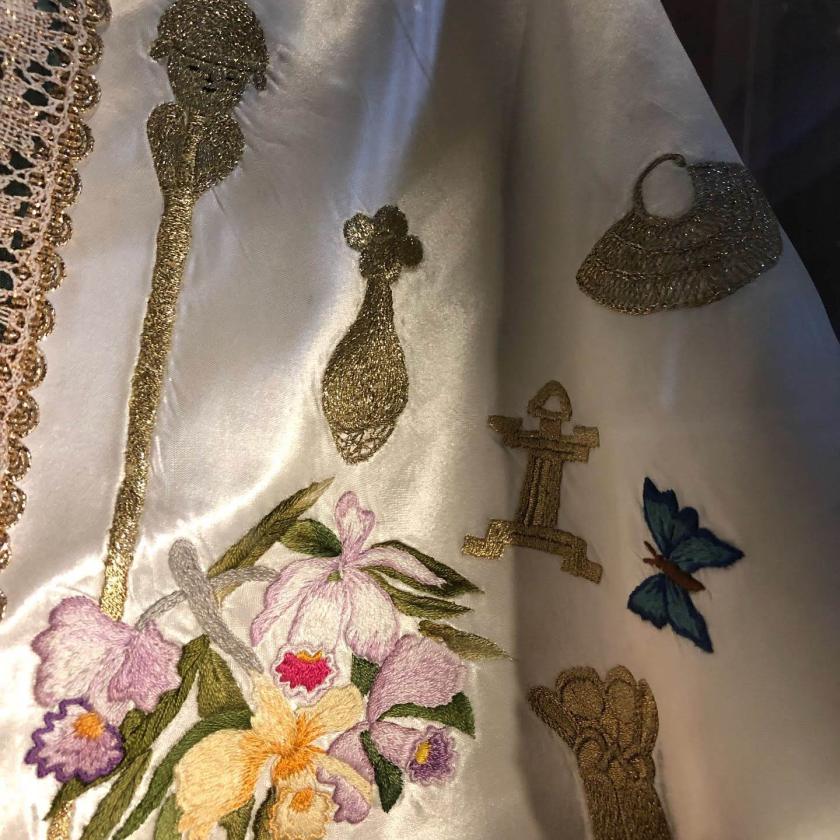
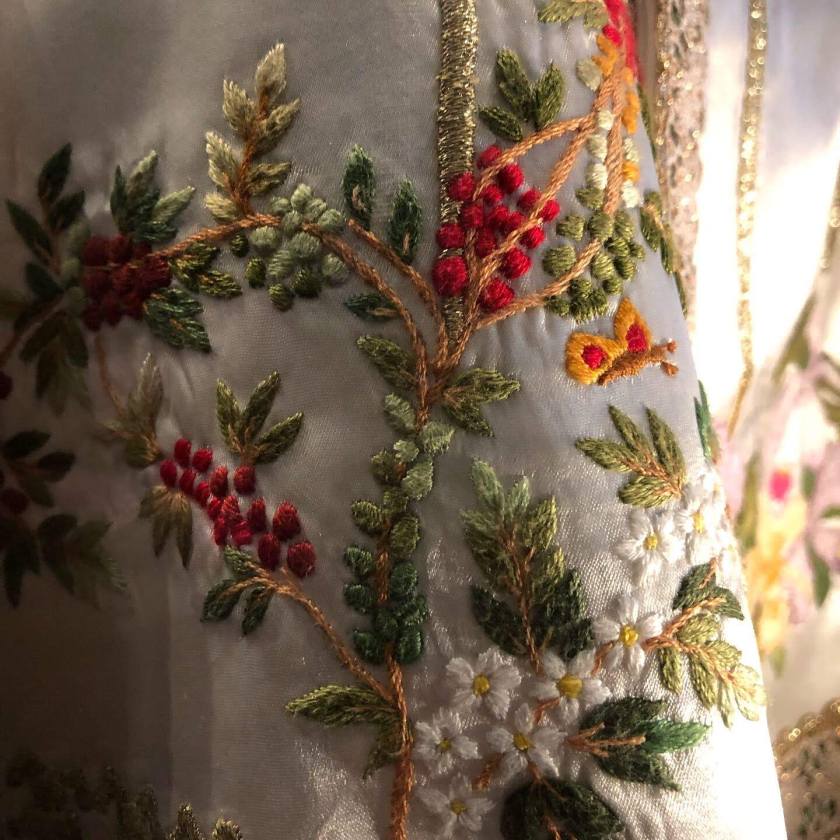
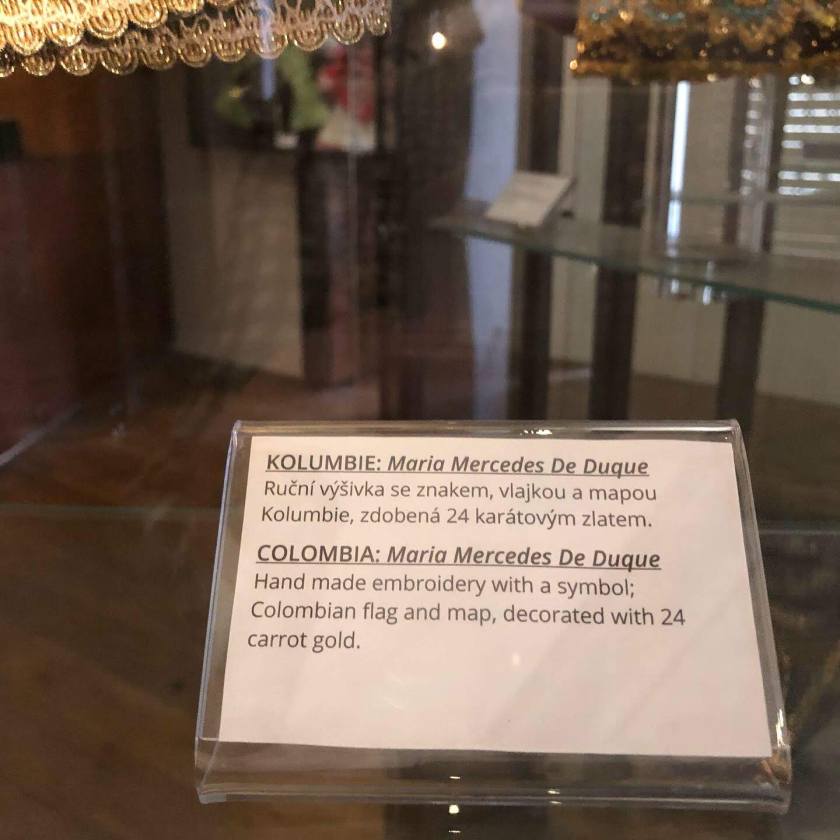
When I was in Prague, Czech Republic, last year (2019), I was able to admire Ms. María Mercedes de Duque’s beautiful work. She made the Infant a dress embroidered with the Colombian national symbols.
The Infant of Prague’s dress.The flag, the shield, and a map in gold with an emerald.Pre-columbian gold artifacts, orchids and butterflies. Can’t forget the coffee.The artist, Ms. María Mercedes de Duque.
Para celebrar, vamos a hablar de algunos de los bordados colombianos.
En Colombia manda el tejido (algodón, lana, caña flecha, fique, calceta de plátano, etc.) pero el bordado también es apreciado.
Calado de Cartago
Comenzamos con el bordado más famoso, el calado de Cartago (Valle del Cauca.)
Penélope, monumento a la bordadora, Cartago, Valle del Cauca, Colombia.
Es una clase de bordado en blanco. Se hace sobre lino o algodón, pero tejido en ligamento tafetán. Se sacan los hilos y luego se vuelven a coser formando diseños geométricos muy lindos al sesgo o biés.
Calados de Cartago en progreso.
Los bordados se usan para decorar sábanas, manteles, cortinas, y las famosas guayaberas caladas
Guayabera calada
Bordado en lana de Fonquetá
En el altiplano cundiboyasense, se produce lana de oveja, y esto llevó al bordado de lana sobre lana.
En Fonquetá, Cundinamarca, se bordan las mantas de lana con hilos de lana.
Bordado en lana del taller artesanal de Fonquetá (@tallerartesanalfonqueta)
Gobelinos de Pasto, Nariño.
En la ciudad de Pasto, Nariño, se hace un bordado sobre paños de lana usando aplicados de tela de algodón, con detalles en hilos de algodón.
Y cuando estuve en Praga, República Checa, pude admirar la labor de doña María Mercedes de Duque, que le hizo un vestido al divino niño de Praga con los símbolos patrios.
Vestido del niño de Praga.La bandera, el escudo y un mapa en oro con una esmeralda.Artefactos pre-colombinos en oro, orquídeas y mariposas.Y el café que no puede faltar.La artista, doña María Mercedes de Duque.
Pero vamos a empezar por lo básico: la diferencia entre tejer y bordar.
Tejer viene primero, y empieza con hilos que al combinarse se vuelven una tela.
Telar antiguo
Hay tejido en telar, con agujas, con ganchos, con las manos, etc.
Para bordar hay que empezar con la tela ya hecha. Los hilos se añaden con agujas y se forman nuevos diseños sobre la tela o en el caso del calado, a través de la tela.
Bordado de punto de cruz sobre tela de lino.
Hay dos categorías mayores:
El de hilos contados y los sin-contar.
Bordados sobre hilos contados
Se hacen sobre telas de tejido plano (ligamento tafetán) generalmente lino o algodón (o alguna mezcla tejida planamente.)
De esta manera los hilos en cualquier dirección se pueden contar. Estas telas se venden por su cuenta de hilos por pulgada:
Por ejemplo, si la tela es de 32 hilos (32 thread count) esto significa que en una pulgada de la tela se pueden contar 32 hilos en dirección vertical. Si contando en dirección horizontal, la cuenta será la misma.
Pulgadas
Centímetros
10
4
14
6
18
7
25
10
32
13
40
16
Equivalente de cuenta de hilos en pulgadas y centímetros.
Al poderse contar los hilos, los diseños se prestan para hacer diagramas y se vuelven repetibles.
Diagrama de diseño de punto de cruz.
Unos de los más populares estilos de hilos contados es el punto de cruz. El punto de cruz es sencillo, sólo hay que hacer una cruz cruzando un o más hilos verticales.
Muy popular también es el bordado en cañamazo (needlepoint.) La tela de cañamazo tiene por tamaño 10 hilos por pulgada (también se encuentran de 12, 14, etc.) Se puede bordar con muchos tipos de puntadas, con hilos gruesos y lana.
Cañamazo con diseños de Bargello por Sarah Barker.
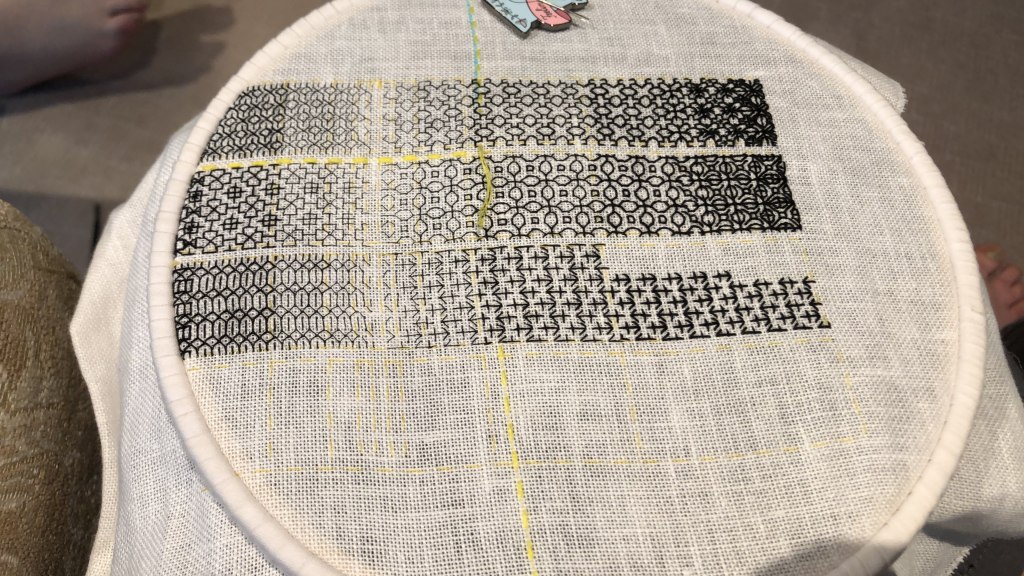
Las labores en negro (blackwork) se pueden hacer en cualquier color, pero tradicionalmente se hacen con hilos negros.
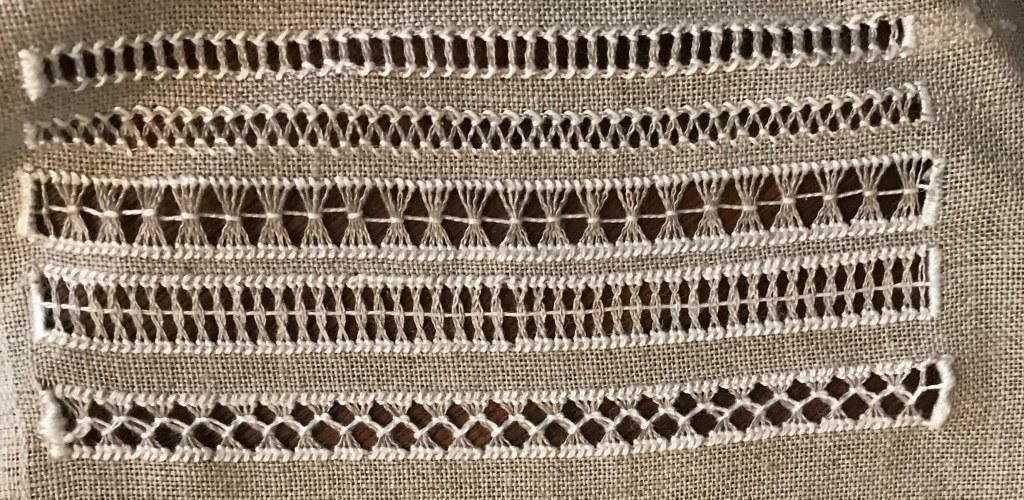
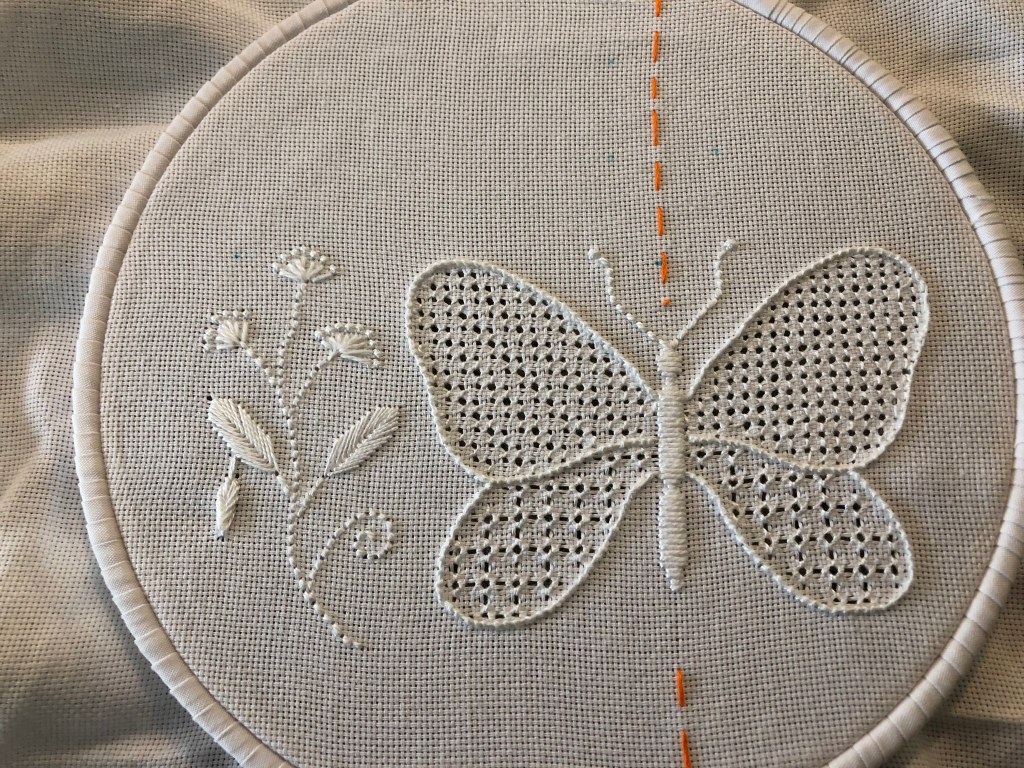
Los calados se hacen cuando se sacan los hilos de la tela y luego se retejen con otros formando nuevos diseños.
Randas o vainicas. Diseño por Linda Driskell
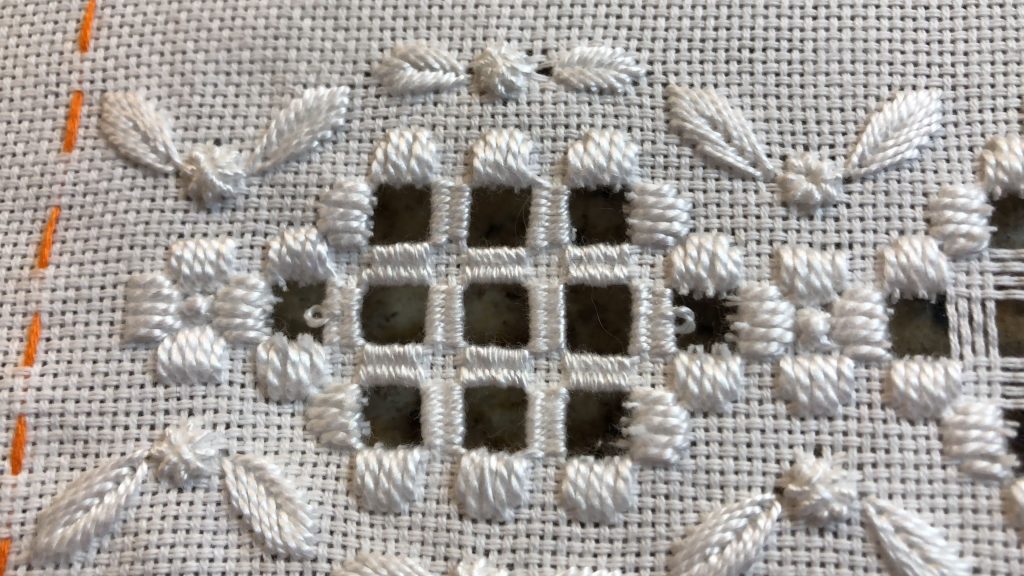
Calado en estilo Hardanger. Diseño por Linda Driskell.Calado apretado. Diseño por Linda Driskell.
Los calados también se pueden hacer sin cortar los hilos si se usa una tela de baja cuenta de hilos (25 hilos por pulgada o menos) el calado se hace al apretar el hilo al pasarlo por la tela abriendo huecos (pulled work.)
Bordados sobre hilos sin cuenta
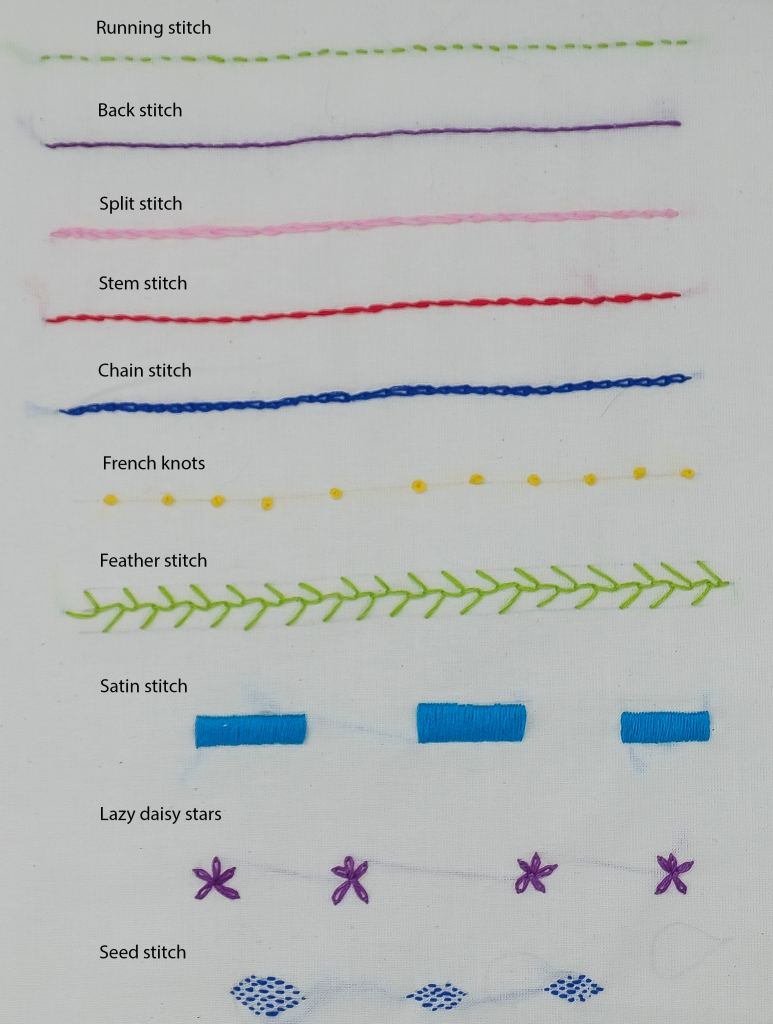
El bordado más conocido es el superficial, donde las puntadas van sobre la tela.
Muestrario con puntadas en tela sin cuenta.
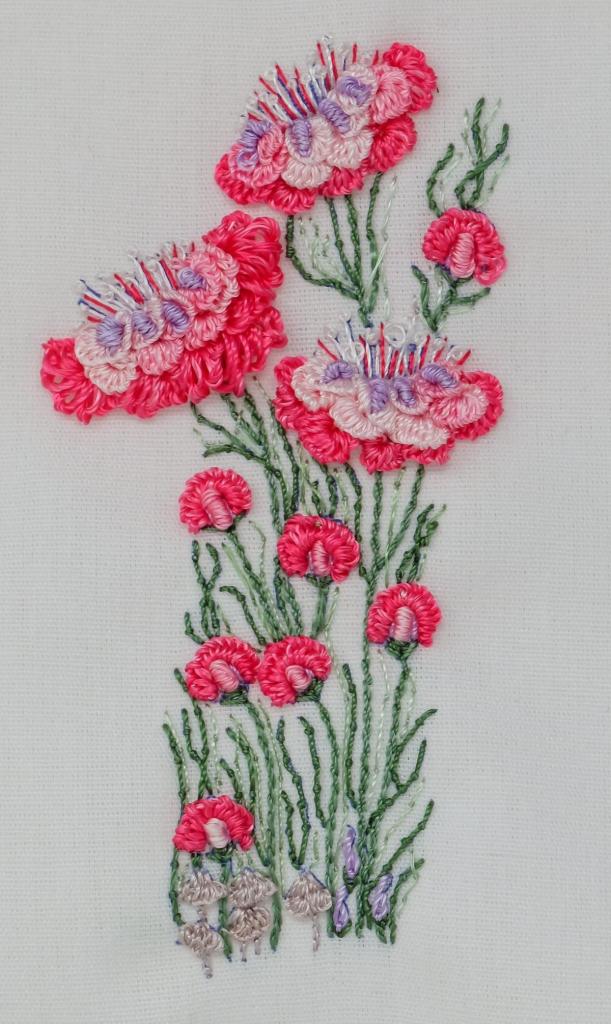
Entre estas están los bordados dimensionales como el brasileño.




















 Empty Thimble